


PSPO I practice test and exam questions: think like a Product Owner
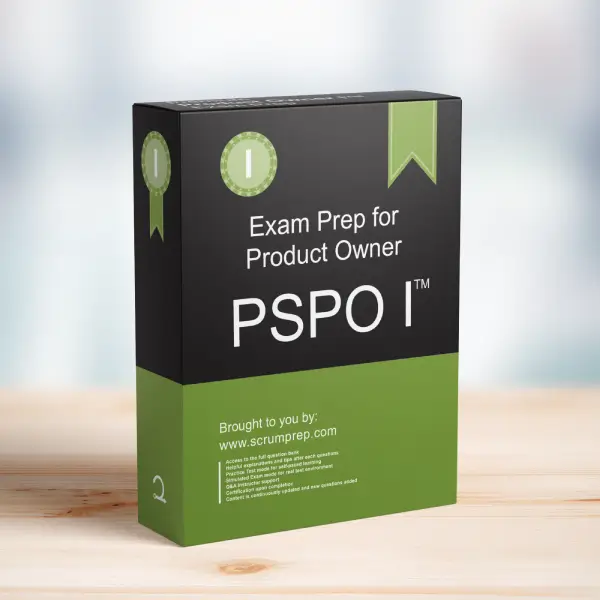
The Professional Scrum Product Owner I (PSPO I, often searched as PSPO 1) checks whether you understand how a Product Owner maximizes value, not just what the Scrum Guide says. Many questions describe a situation with a stakeholder, a manager or a team and ask what the Product Owner should do. Our practice tests train exactly that judgement.
Try 10 free PSPO I sample questions below, no sign-up needed.
PSPO I exam at a glance
| Official PSPO I exam | ScrumPrep PSPO I practice tests | |
|---|---|---|
| Questions | 80 (68 correct to pass) | 320 in the bank; 80 per timed mock |
| Time limit | 60 minutes | 60 minutes in Timed Mode; none in Practice Mode |
| Passing score | 85% | Scored the same way, with a per-topic breakdown |
| Question types | Multiple choice, multiple answer, true/false | Same three types |
| Price | Official exam fee: $200 per attempt, paid to Scrum.org | ScrumPrep practice tests: $29, unlimited attempts. The exam fee is not included. |
| Based on | 2020 Scrum Guide | 2020 Scrum Guide |
Please note: ScrumPrep sells practice tests, not the exam. The $29 covers our PSPO I practice tests only. You book and pay for the official PSPO I exam separately with Scrum.org.
What the PSPO I exam tests
- Managing products with agility: product value, the Product Goal, product vision and strategy, and measuring value with evidence rather than output.
- Product Backlog management: ordering, refinement, who can change the backlog and when, and how to handle requests from stakeholders.
- Stakeholders and customers: who decides what, how to say no, and how the Sprint Review is used to gather feedback.
- Forecasting and release planning: why forecasts are not commitments and how releases can happen within a Sprint.
- The Scrum framework from the Product Owner’s seat: how the Product Owner works with the Developers and the Scrum Master in each event.
Free PSPO I practice test: 10 sample questions
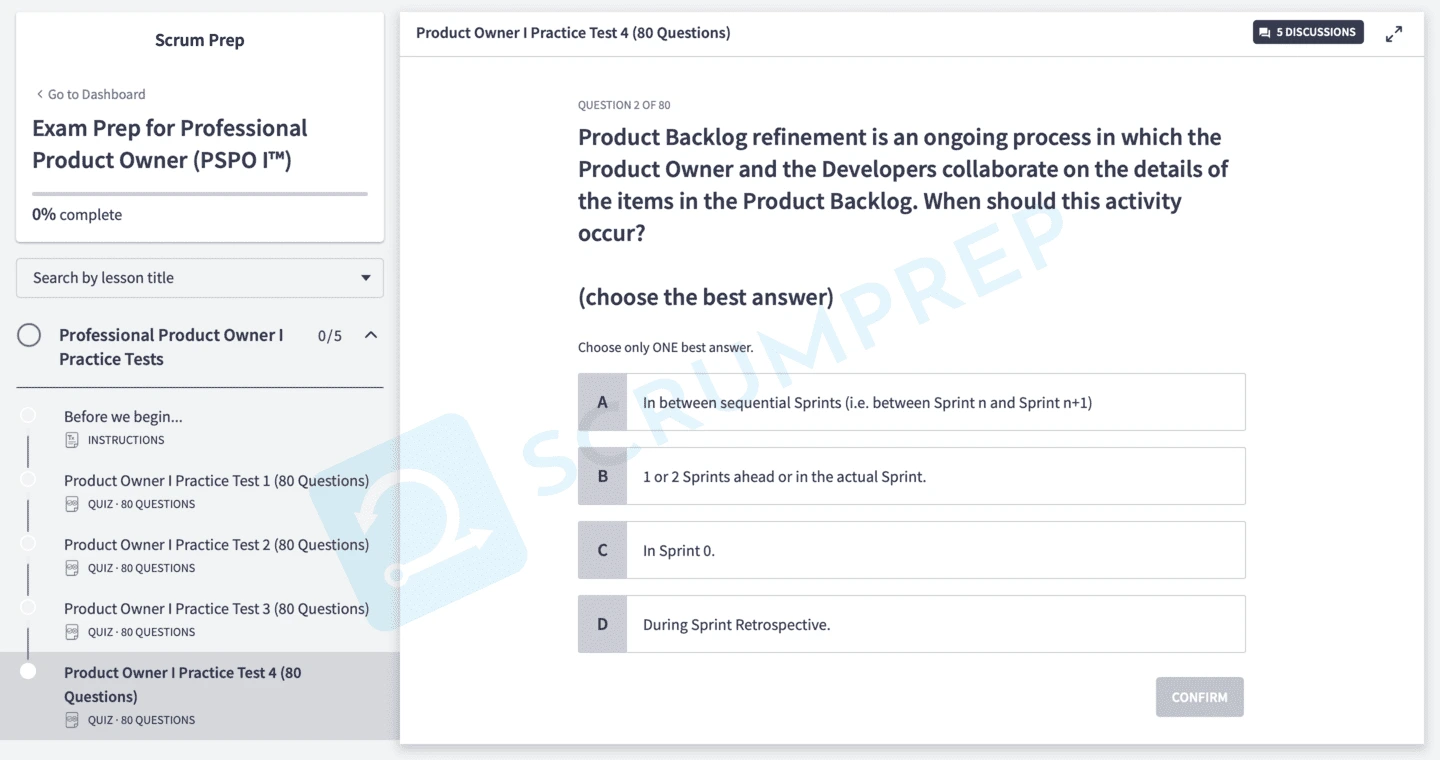
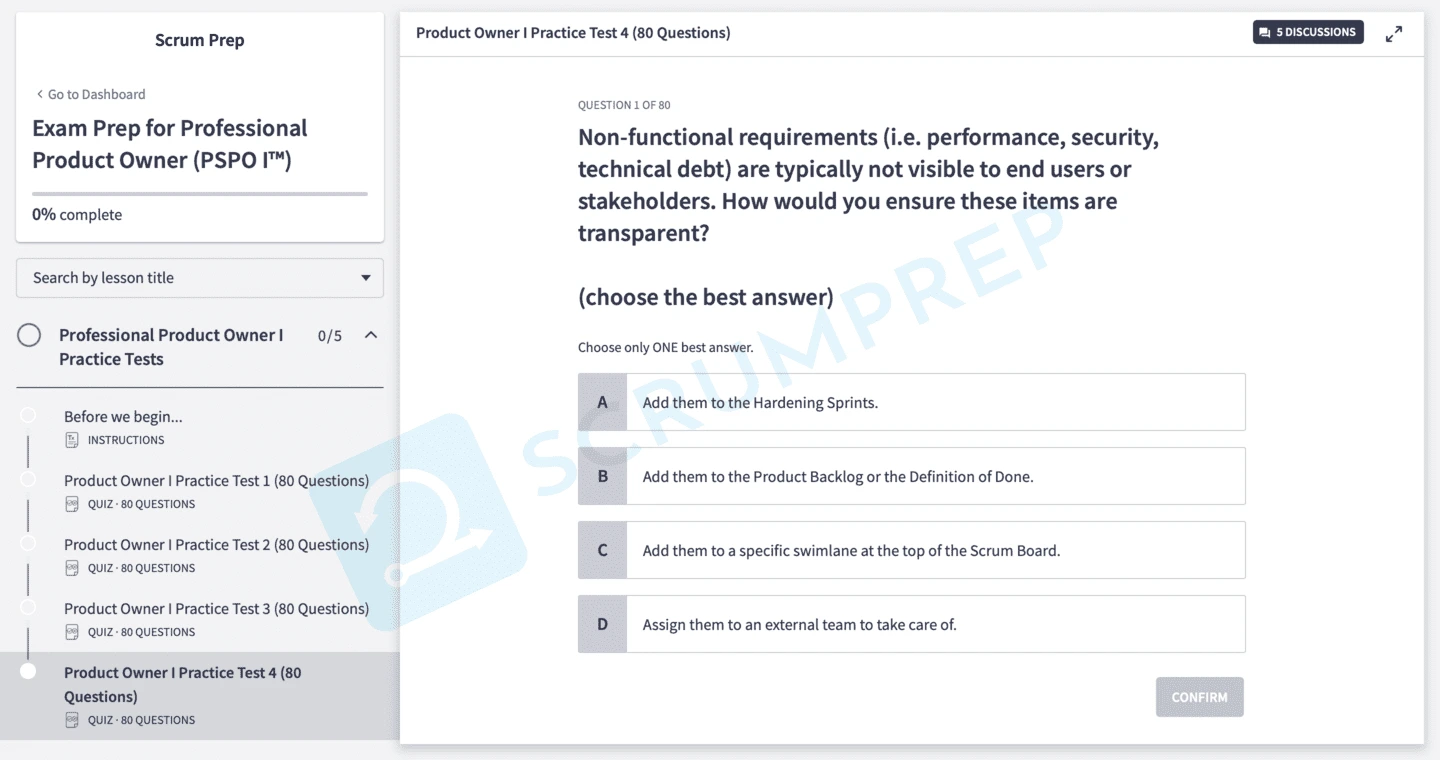
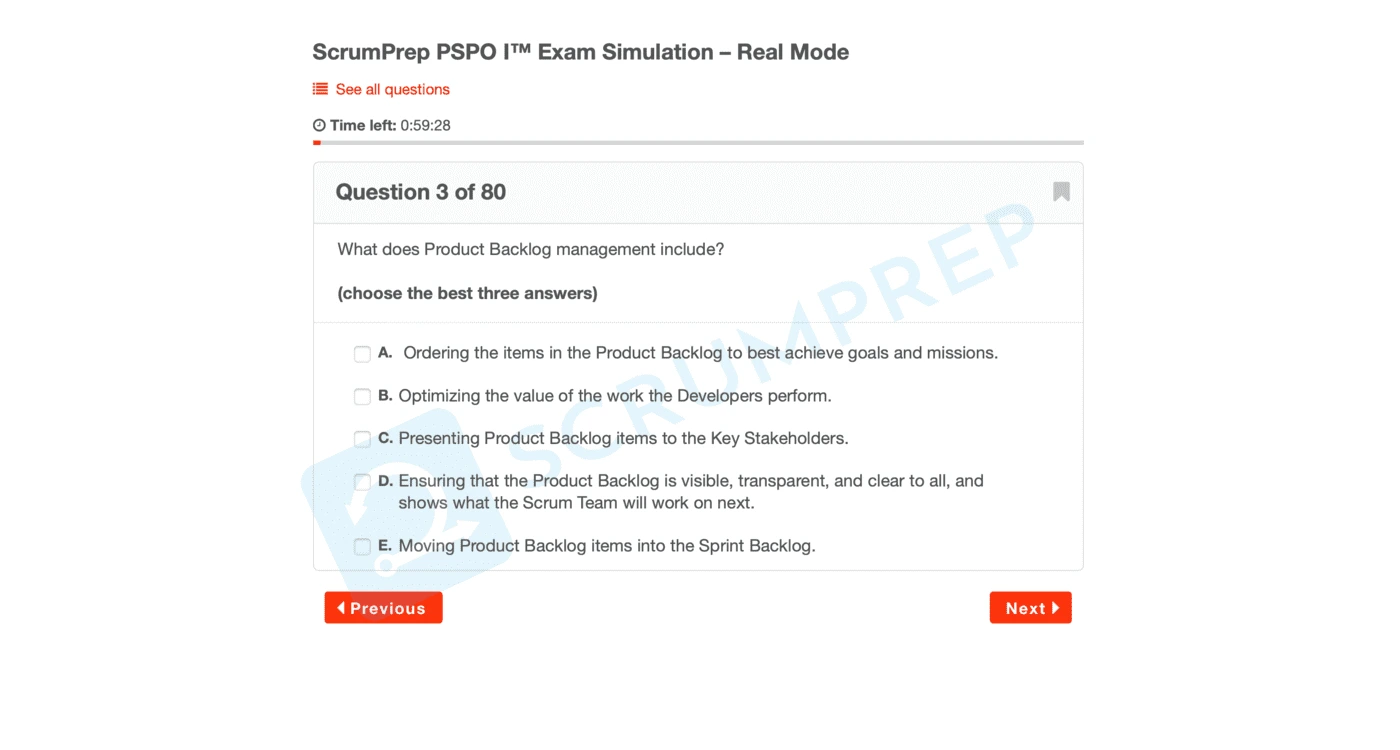
Try these 10 questions from the ScrumPrep PSPO I question bank. Open a question, pick your answer, then tap Check answer. Each answer links to a full explanation. Like the real exam, a multiple-answer question only counts when every choice is right.
Question 1: Which is NOT a valid consideration when ordering a Product Backlog? (choose the best answer)
Check answer
Correct answer: D. Tools and techniques are not a valid consideration when ordering the Product Backlog. Strategy, risk, customer importance and dependencies all affect value and sequence, while tools only affect how the work gets done. Read the full explanation
Question 2: When does a Developer become accountable for the value of a Product Backlog item selected for the Sprint? (choose the best answer)
Check answer
Correct answer: B. Never. No individual Developer becomes accountable for the value of a single item, because the whole Scrum Team is accountable for creating value every Sprint. Read the full explanation
Question 3: True or False: The Product Owner must write all of the Product Backlog items (e.g., user stories, requirements, etc.) on the Product Backlog before handing them over to the Scrum Team.
Check answer
Correct answer: B. False. The Product Owner does not have to write every Product Backlog item, and work is never handed over to the Scrum Team. The Product Owner can delegate this work while staying accountable. Read the full explanation
Question 4: Which metrics will help a Product Owner determine if a product is delivering value? (choose the best two answers)
Check answer
Correct answer: A and B. Time to market and customer satisfaction help a Product Owner judge whether the product delivers value. Velocity, productivity and scope implemented measure output, not value. Read the full explanation
Question 5: What might indicate to a Product Owner that they need to work more with the Scrum Team? (choose the best answer)
Check answer
Correct answer: B. If the Increment at the Sprint Review is not what the Product Owner thought she asked for, she needs to work more closely with the Scrum Team. That gap shows the Developers and Product Owner did not build a shared understanding during the Sprint. Read the full explanation
Question 6: The “cone of uncertainty” can be used to do what? (choose the best answer)
Check answer
Correct answer: D. The cone of uncertainty illustrates that the further out a forecast goes, the less certain it becomes. It does not fix project cost up front or justify cutting quality. Read the full explanation
Question 7: Why is it important that there is only one Product Owner per product? (choose the best three answers)
Check answer
Correct answer: A, B and D. One Product Owner per product makes it clear who is accountable for the product’s value, who decides the Product Backlog order, and it avoids slow, confused decisions. Stakeholder convenience and vacation cover are not the reasons. Read the full explanation
Question 8: How much time must a Product Owner spend with the Developers? (choose the best answer)
Check answer
Correct answer: D. The Product Owner should spend enough time with the Developers to be confident the Increment will deliver the intended value. There is no fixed percentage. Read the full explanation
Question 9: True or False: During the Sprint Review it is up to the stakeholders to reorder the Product Backlog.
Check answer
Correct answer: B. False. Stakeholders do not reorder the Product Backlog during the Sprint Review. They give feedback, and the Product Owner remains accountable for ordering. Read the full explanation
Question 10: When should the Product Owner update the project plan? (choose the best answer)
Check answer
Correct answer: A. The Product Backlog is the plan in Scrum, and the Product Owner updates it whenever new information or insights emerge. There is no separate project plan to maintain on a schedule. Read the full explanation
How did you do? The real PSPO I exam needs 85%, which is 9 out of 10 here. For more free practice, take the free PSPO I quiz. For the full question bank, timed mock exams and an explanation for every question, get the PSPO I Exam Prep on this page.
Two ways to prepare: Practice Mode and Mock Exam Mode
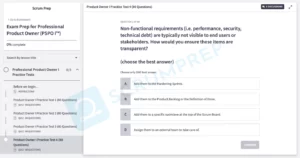
- Practice Mode: study at your own pace. Choose how many questions you want in each session, from a short set to all 320 questions, with no time limit and an in-depth explanation after every answer. Progress saves automatically.
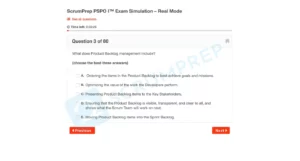
- Mock Exam Mode (Timed Mode): sit a full mock exam that mimics the real one: 80 random questions in 60 minutes, scored at the end. Every attempt draws a new random set.
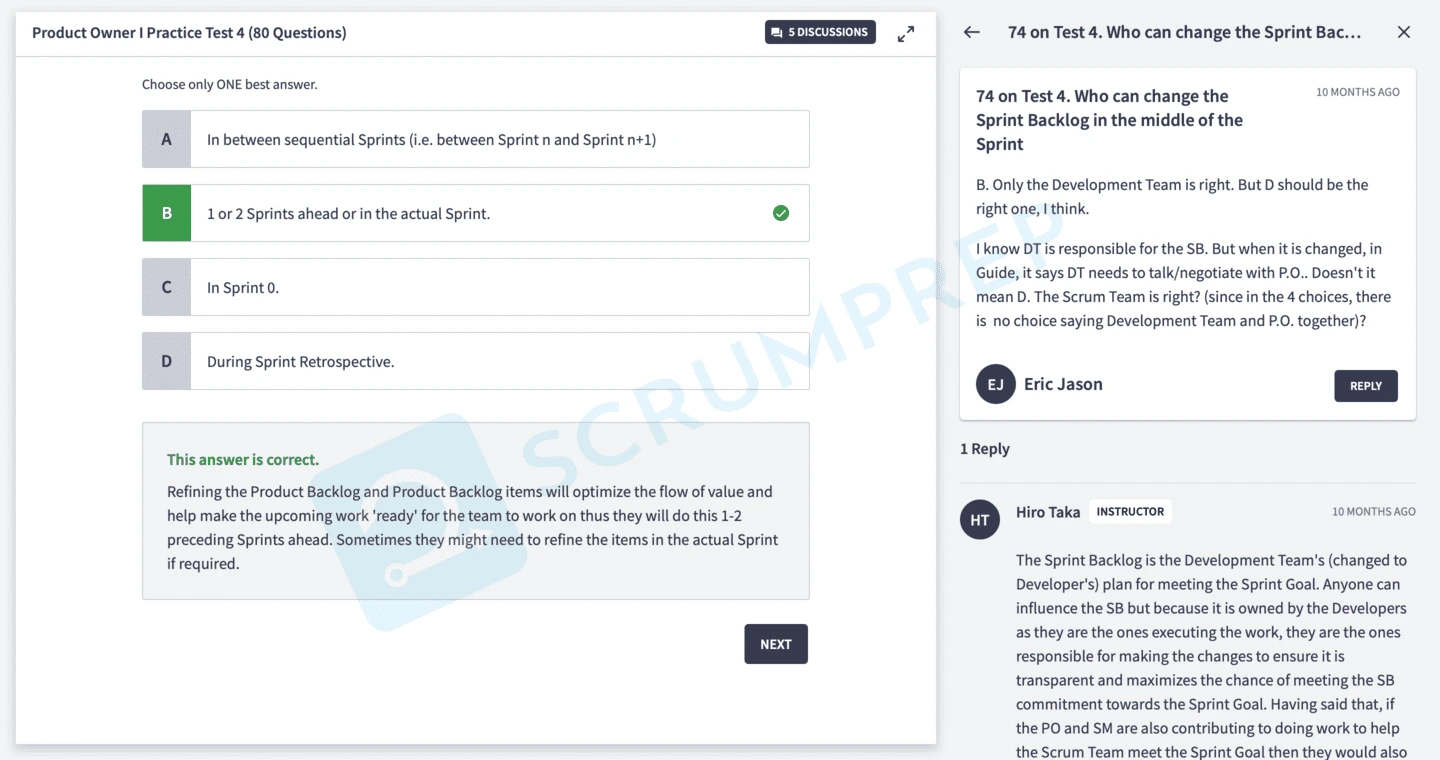
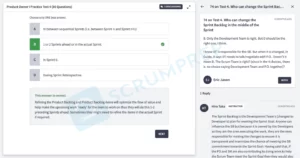
- In-depth explanations: every question comes with a detailed explanation that walks you through what the question is really asking and why the correct answer is right, so you understand the reasoning instead of memorizing answers.
- Benchmarking: compare your scores with other candidates and see which topics need work.
- Lifetime access with updates whenever Scrum.org changes the exam.
Why ScrumPrep
Scrum.org’s free Product Owner Open assessment has only 15 questions, so it shows whether you are close but not where you are weak. Our 320 questions cover every focus area with full explanations. Rated 4.98 out of 5 from more than 4,500 reviews, and backed by a 100% money-back guarantee.
- Trusted since 2016: thousands of candidates have prepared for their certification exams with ScrumPrep.
- Matched to the real exam: questions are written to match the real PSPO I exam’s format, difficulty and topics, and checked against the current official exam content.
- Prompt support: questions about an answer or your account? Contact us and we respond promptly.
- Pay once: one payment, no subscription required.
- Study anywhere: practice on your phone, tablet or computer.
PSPO I FAQ
Is PSPO I the same as PSPO 1?
Yes. Scrum.org writes it with a Roman numeral, but it is the same exam.
Do I need to be a Product Owner to pass?
No. Business analysts, project managers and Scrum Masters pass it regularly. You do need to think in terms of value and ownership, which the scenario questions train.
Should I take PSM I or PSPO I first?
They share the Scrum framework, so either order works. If you lead a product or backlog, start with PSPO I.
Does PSPO I expire?
No. It is a lifetime certification with no renewal fee.
Are these real exam questions or dumps?
Neither. Scrum.org’s real questions are confidential, and dumps break its rules and can cost you the certification. These are original questions written to the same format and topics, each with an in-depth explanation.
What if I don’t pass?
Our money-back guarantee covers you. See the guarantee terms.
Read the free PSPO I exam guide, or try the free PSPO I quiz first.
Buying for a team? Bulk discounts are available. Contact us for details.


Olivia C. –
I loved that each question focused on decision-making and accountability.
Henry N. –
I feel prepared not only for the exam but also for product responsibilities at work.
Logan I. –
This resource helped me align product outcomes with stakeholder goals.
Samuel V. –
The structure of the tests helped build my confidence over time.
Lucas G. –
The emphasis on outcomes helped reinforce real-world thinking.
Liam G. –
The format helped me manage time better and build test-day confidence.
Isabella Z. –
These questions helped me think like a true Product Owner, not just a test-taker.
Noah B. –
I became more intentional about backlog refinement thanks to these scenarios.
Grace B. –
I now have a clearer view of how the Product Goal aligns with the Scrum framework.
Ella H. –
I appreciated the focus on value delivery and customer-centric thinking.