

Importance of Cross-Team Refinement in Nexus
In a Nexus, managing dependencies effectively is crucial to ensure smooth progress and avoid bottlenecks. Cross-Team Refinement helps visualize and address these dependencies, allowing teams to plan and coordinate their work efficiently.
Exam Question
During Cross-Team Refinement, the ordered Product Backlog (1 through 9) is mapped out so the Nexus can visualize dependencies. For example, PBI 5 for Team Orange is dependent on Team Red completing PBI 1.
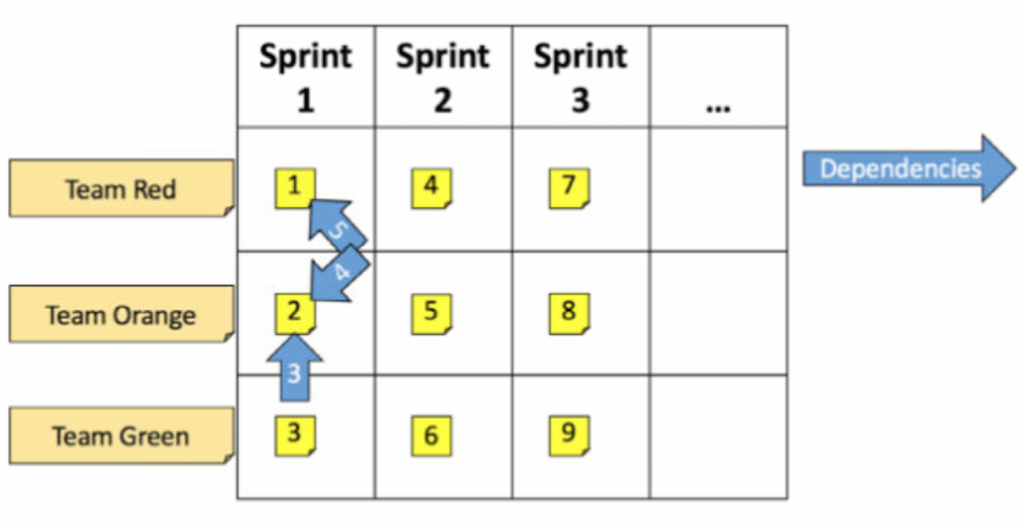
All else being equal, which PBI is most concerning?
(choose the best answer)
A. PBI 1, because it is the first piece of work with a dependency.
B. PBI 2, because there is a dependency with a different team on work that occurs within the same Sprint.
C. PBI 1, because it is on the top of the Product Backlog.
D. PBI 2, because it has the most dependencies.
Correct Answer
D. PBI 2, because it has the most dependencies.
Explanation
Correct Answer
D. PBI 2, because it has the most dependencies:
PBI 2 is the most concerning because it has the most dependencies. The more dependencies a Product Backlog Item (PBI) has, the higher the risk of delays and complications. Each dependency introduces a potential point of failure or delay, making it more challenging to complete the work on time. In this case, managing PBI 2 requires careful coordination and communication between the teams to ensure that all dependencies are addressed promptly.
Why the Other Options Are Less Effective
A. PBI 1, because it is the first piece of work with a dependency:
While PBI 1 is the starting point for a series of dependencies, it being the first piece of work does not inherently make it the most concerning. The primary concern should be the impact of multiple dependencies on the workflow and Sprint goals.
B. PBI 2, because there is a dependency with a different team on work that occurs within the same Sprint:
Although dependencies within the same Sprint can be challenging, the number of dependencies is a more critical factor. PBI 2 having the most dependencies makes it more complex to manage.
C. PBI 1, because it is on the top of the Product Backlog:
The position of PBI 1 at the top of the Product Backlog indicates its priority, but it does not necessarily mean it is the most concerning in terms of dependencies. The focus should be on how multiple dependencies affect the ability to deliver work within the Sprint.
Benefits of Cross-Team Refinement
- Improved Coordination: Visualizing dependencies helps teams coordinate their efforts and plan their work more effectively.
- Early Identification: Identifying dependencies early allows teams to address potential issues before they become blockers.
- Enhanced Transparency: Making dependencies transparent promotes collaboration and collective problem-solving.
Relevance to the SPS Exam
Understanding how to manage dependencies in a Nexus is essential for the SPS exam. It demonstrates the ability to apply scaled Scrum practices to real-world scenarios, ensuring that large-scale projects are managed efficiently.
Key Takeaways
- Identifying and managing dependencies early is crucial for successful Sprint execution.
- Dependencies increase the complexity of work and require careful coordination.
- Cross-Team Refinement helps visualize and address dependencies, promoting better planning and collaboration.
Conclusion
Effective management of dependencies is vital in a Nexus environment. By focusing on dependencies with the most significant impact, teams can ensure smoother progress and higher quality delivery.

Get ready for the official SPS exam
182 SPS practice questions, each with an in-depth explanation like the one above.
- Practice Mode: study at your own pace and choose the test length.
- Mock Exam Mode: 40 random questions in 60 minutes, like the real exam.
$29 is ScrumPrep's one-time price. The official SPS exam fee is paid separately to Scrum.org.
More SPS exam questions
- During the Nexus Sprint Planning, representatives from each of the 9-member Scrum Teams identify many dependencies. This makes it hard for them to choose the work they could pull into their individual teams for the next Sprint. No matter how they reorganize the Product Backlog items, they continually find more or new dependencies. What should the Scrum Teams do to effectively deal with their dependencies?
- From the list below, what is the most important concern for multiple Scrum Teams when they are working from the same Product Backlog?
- If two Scrum Teams are added to the development of a product that previously had only one Scrum Team, what will be the immediate impact on the productivity of the original Scrum Team?” (SPS)
- When many Scrum Teams are working on the same product, should all of their Increments be integrated every Sprint?” (SPS)
- True or False: A Nexus Integration Team is accountable for there being an Integrated Increment at the end of each Sprint.