




CAPM practice test and practice exam questions
The Certified Associate in Project Management (CAPM) from PMI is the entry-level project management certification. The exam has 150 questions in three hours and covers predictive, agile and business analysis approaches, so it rewards broad knowledge rather than experience. Our CAPM practice exams cover every domain, with a full-length timed mock that matches the real one.
Try 10 free CAPM sample questions below, no sign-up needed.
CAPM exam at a glance
| Official CAPM exam | ScrumPrep CAPM practice tests | |
|---|---|---|
| Questions | 150 (135 scored, 15 unscored) | 570 in the bank; 150 per timed mock |
| Time limit | 180 minutes, with a 10-minute break | 180 minutes in Timed Mode; none in Practice Mode |
| Question types | Multiple choice and drag-and-drop | Multiple choice |
| Price | Official exam fee: Set by PMI and paid to PMI; lower for PMI members | ScrumPrep practice tests: $29, unlimited attempts. The exam fee is not included. |
| Based on | PMI CAPM Examination Content Outline | The same domains |
Please note: ScrumPrep sells practice tests, not the exam. The $29 covers our CAPM practice tests only. You book and pay for the official CAPM exam separately with PMI.
What the CAPM exam tests
- Project management fundamentals: life cycles, roles, processes and core concepts.
- Predictive, plan-based methods: scope, schedule, cost and the plan-driven approach.
- Agile frameworks and methods: Scrum, Kanban and adaptive planning.
- Business analysis: requirements, stakeholders and analysis techniques.
Free CAPM practice test: 10 sample questions
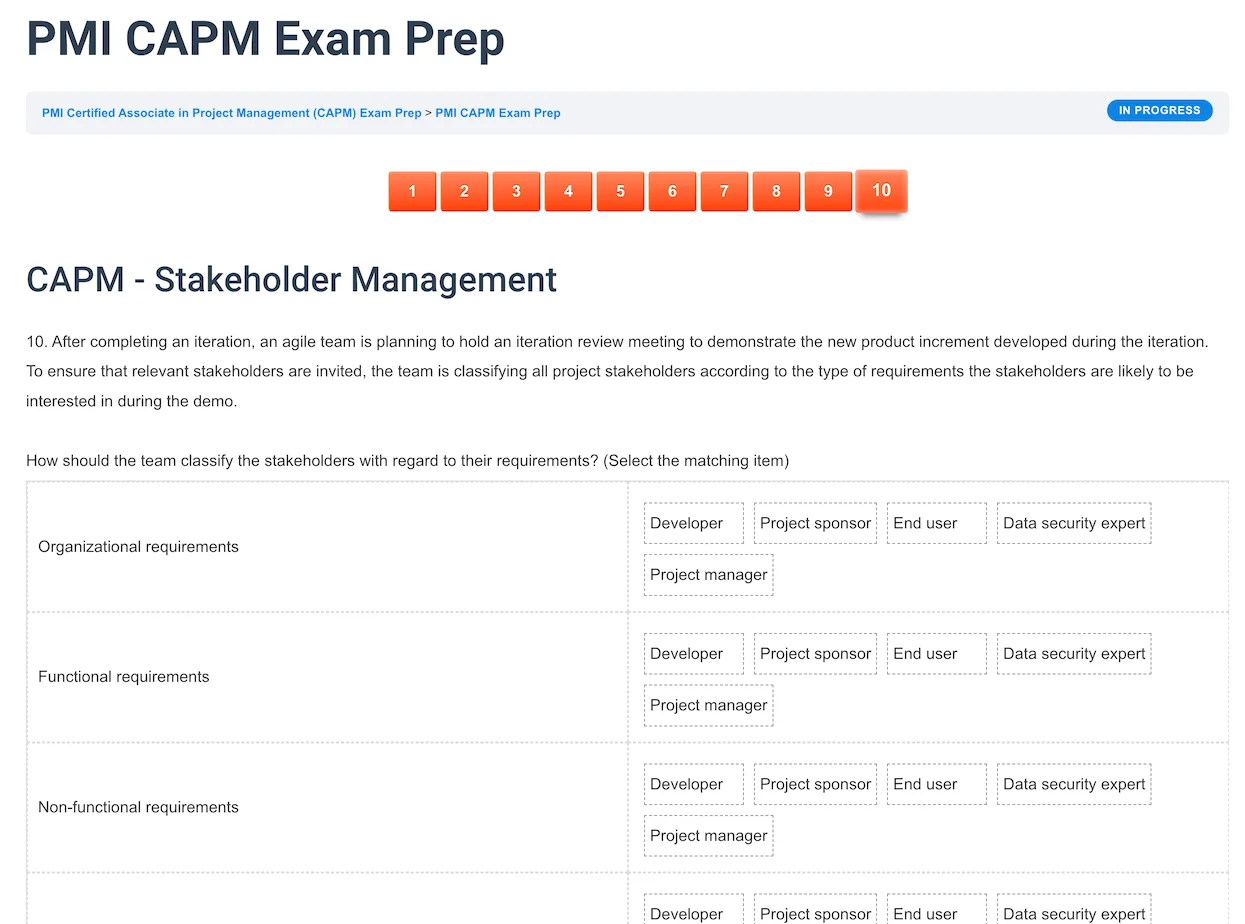
Try these 10 questions from the ScrumPrep CAPM question bank. Open a question, pick your answer, then tap Check answer to see the correct answer and why.
Question 1: You are working at a firm where your responsibilities include selecting the right programs or projects, prioritizing the work, and providing the needed resources. Your primary objective is to manage all of the various programs, projects, and operations together as a group to meet the firm’s strategic business objectives. Which of the following best describes the work you are performing? (choose the best answer)
Check answer
Correct answer: D. Portfolio management selects, prioritizes and resources programs, projects and operations together to meet strategic objectives. Program management covers only related projects.
Question 2: What is the difference between stakeholders and project team members? (choose the best answer)
Check answer
Correct answer: C. Team members are always stakeholders, but many stakeholders, such as customers, sponsors and suppliers, are not on the project team.
Question 3: In planning a project, a project manager wants to prepare a detailed list of individual project risks and identify potential risk responses along with likely risk owners. What should the project manager do? (choose the best answer)
Check answer
Correct answer: A. The risk register lists individual project risks with their potential owners and responses. It is created when risks are identified, before qualitative or quantitative analysis.
Question 4: As part of continuous improvement, the team members are looking for ways to optimize the process they use to conduct the work. At the iteration retrospective, an agile coach suggests using a lean production method, which would allow the team to analyze the process and identify and subsequently remove waste. How should the team implement the agile coach’s suggestion? (choose the best answer)
Check answer
Correct answer: A. Value stream mapping is a lean technique for mapping a process, finding the steps that add no value, and removing that waste.
Question 5: An agile team is in the middle of a sprint when the sponsor asks the project manager to stop work on several user stories in the current sprint. With a recent news announcement of new technology soon to hit the market, the sponsor is inclined to think that these user stories would be of little value. What should the project manager do? (choose the best answer)
Check answer
Correct answer: C. The Product Owner owns the backlog priorities. The project manager should check with the Product Owner rather than act on the sponsor’s request alone or ignore it.
Question 6: During a Sprint Planning, the Scrum Team is arguing over 115 story points’ worth of user stories that the Product Owner is pushing to be completed in the upcoming Sprint. However, the Developers’ average velocity is only 100 story points. Who makes the final decision on how many story points will be targeted for completion during a Sprint? (choose the best answer)
Check answer
Correct answer: B. The Developers decide how much work they can take on in a Sprint. With an average velocity of 100 points, they should not commit to 115.
Question 7: An agile team is trying to determine the ideal iteration length. The team members are having a long and intense argument about it, but no one is willing to compromise. The scrum master is called in to help resolve the conflict. What is the best course of action for a scrum master? (choose the best answer)
Check answer
Correct answer: B. The Scrum Master facilitates and coaches rather than deciding for the team. Helping the team compare the pros and cons of each option moves it toward its own decision.
Question 8: You are managing a project with a budget of $20,000. You have spent $17,000 so far, and the project is 75% complete. You have performed a variance analysis and determined that the estimate at completion (EAC) will be $22,667. What is the efficiency that must be maintained in order to complete the project with the current EAC? (choose the best answer)
Check answer
Correct answer: D. This asks for the to-complete performance index (TCPI) against the EAC: remaining work divided by remaining funds = (20,000 – 15,000) / (22,667 – 17,000) = 5,000 / 5,667 = 0.882.
Question 9: You are the project manager reviewing the results of a quality report prepared by a team external to the project. The quality report indicates settings on a piece of equipment that are not configured to the exact specifications outlined in the quality management plan. What should you do immediately? (choose the best answer)
Check answer
Correct answer: B. A nonconformity found in a quality report is a current problem, so record it in the issue log first. Then it can be assigned and resolved.
Question 10: An agile team delivers the product to the customer several weeks earlier than initially planned. However, the customer is unpleasantly surprised by the outcome and indicates that the product does not meet their expectations. What might the agile leader have done differently to avoid or, at least, mitigate this situation? (choose the best answer)
Check answer
Correct answer: D. Iteration reviews are the regular feedback loop with the customer. Making sure the customer took part in them would have shown the gap between expectations and the product early.
How did you do? PMI does not publish the CAPM pass mark, so aim to get these right consistently before you book. For more free practice, take the free CAPM quiz. For the full question bank, timed mock exams and an explanation for every question, get the CAPM Exam Prep on this page.
Two ways to prepare: Practice Mode and Mock Exam Mode
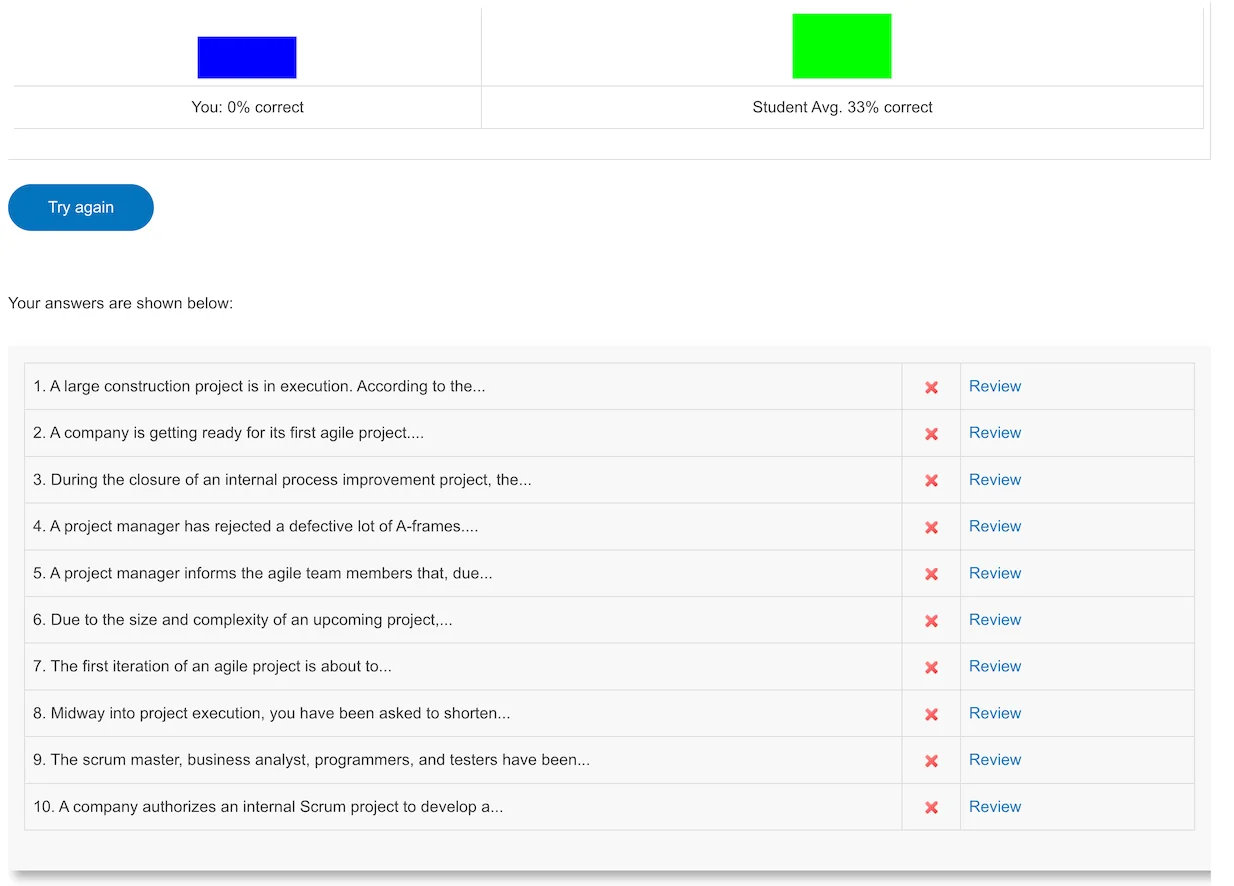
- Practice Mode: study at your own pace. Choose how many questions you want in each session, from a short set to all 570 questions, with no time limit and an in-depth explanation after every answer. Progress saves automatically.
- Mock Exam Mode (Timed Mode): sit a full mock exam that mimics the real one: 150 random questions in 180 minutes, scored at the end. Every attempt draws a new random set.
- In-depth explanations: every question comes with a detailed explanation that walks you through what the question is really asking and why the correct answer is right, so you understand the reasoning instead of memorizing answers.
- Benchmarking: compare your scores with other candidates and see which topics need work.
- Lifetime access with updates whenever PMI changes the exam.
Why ScrumPrep
CAPM is one of the most searched project management practice tests. Our 570 questions cover all four domains, with a full explanation for each. Rated 5.00 out of 5 from more than 3,400 reviews, and backed by our money-back guarantee.
- Trusted since 2016: thousands of candidates have prepared for their certification exams with ScrumPrep.
- Matched to the real exam: questions are written to match the real CAPM exam’s format, difficulty and topics, and checked against the current official exam content.
- Prompt support: questions about an answer or your account? Contact us and we respond promptly.
- Pay once: one payment, no subscription required.
- Study anywhere: practice on your phone, tablet or computer.
CAPM FAQ
Who can take the CAPM?
Anyone with a secondary degree and 23 hours of project management education. No project experience is required.
How long is CAPM valid?
Three years. You renew it by earning 15 professional development units.
Should I take CAPM or PMP?
CAPM is for people starting out. PMP needs several years of project experience and is the more advanced certification.
Are these real exam questions or dumps?
Neither. PMI’s real questions are confidential, and using dumps breaks its exam rules and can cost you the certification. These are original questions written to the same format and topics, each with an in-depth explanation.
What if I don’t pass?
Our money-back guarantee covers you. See the guarantee terms.
Read the free CAPM exam guide, or try the free CAPM quiz first.
Buying for a team? Bulk discounts are available. Contact us for details.

Grace N. –
The mock tests helped me spot my weak areas quickly.
Sophia N. –
The design made it easy to track my learning progress.
Liam G. –
Every question helped me feel more comfortable with the PMBOK.
Olivia J. –
I’m thankful for how accessible and effective this prep was.
Alexander H. –
The exam felt manageable thanks to these prep sessions.
Elijah D. –
The real-world examples helped solidify the concepts.
Grace B. –
I appreciated the balance of theory and application.
Henry P. –
It helped me see the value of a structured project framework.
William C. –
I now feel ready to take on real projects with confidence.
James F. –
I finally understood the difference between monitoring and controlling.