




SAFe SPC practice test and exam questions
The SAFe Practice Consultant (SPC) exam follows the Implementing SAFe course and certifies you to lead SAFe transformations and teach SAFe courses. It has 60 questions in 120 minutes, needs 83% to pass, and retakes cost $250, so it pays to be ready on the first attempt. Questions span the whole framework plus the SAFe Implementation Roadmap. Our SPC practice tests cover both.
Try 10 free SAFe SPC sample questions below, no sign-up needed.
SAFe SPC exam at a glance
| Official SAFe SPC exam | ScrumPrep SAFe SPC practice tests | |
|---|---|---|
| Questions | 60, multiple choice | 100+ in the bank; 60 per timed mock |
| Time limit | 120 minutes | 120 minutes in Timed Mode; none in Practice Mode |
| Passing score | 83% | Scored at the end, with a breakdown by topic |
| Format | Web-based, closed book, timed | The same, without the pressure of a real attempt |
| Price | Official exam fee: Included with your SAFe course; retakes $250, paid to Scaled Agile | ScrumPrep practice tests: $29, unlimited attempts. The exam fee is not included. |
Please note: ScrumPrep sells practice tests, not the exam. The $29 covers our SAFe SPC practice tests only. The official SAFe SPC exam comes with your SAFe course from Scaled Agile, not from ScrumPrep.
What the SAFe SPC exam tests
- Business agility: the SAFe core competencies and why organizations need them.
- Mindset, values and principles: the Lean-Agile mindset and the ten SAFe principles.
- Agile Release Trains: team and technical agility, PI Planning and ART execution.
- Lean Portfolio Management: strategy, portfolio Kanban and Lean budgets.
- Implementation Roadmap: from reaching the tipping point to launching ARTs and sustaining the change.
- AI-empowered SAFe: using AI in the role, writing good prompts and using AI responsibly.
Free SAFe SPC practice test: 10 sample questions
Try these 10 questions from the ScrumPrep SAFe SPC question bank. Open a question, pick your answer, then tap Check answer to see the correct answer and why.
Question 1: Which SAFe role helps to coordinate between multiple ARTs within a Value Stream? (choose the best answer)
Check answer
Correct answer: A. The Solution Train Engineer is the servant leader and coach for a Solution Train, coordinating several ARTs and suppliers that build one large solution. The RTE does the same job for a single ART.
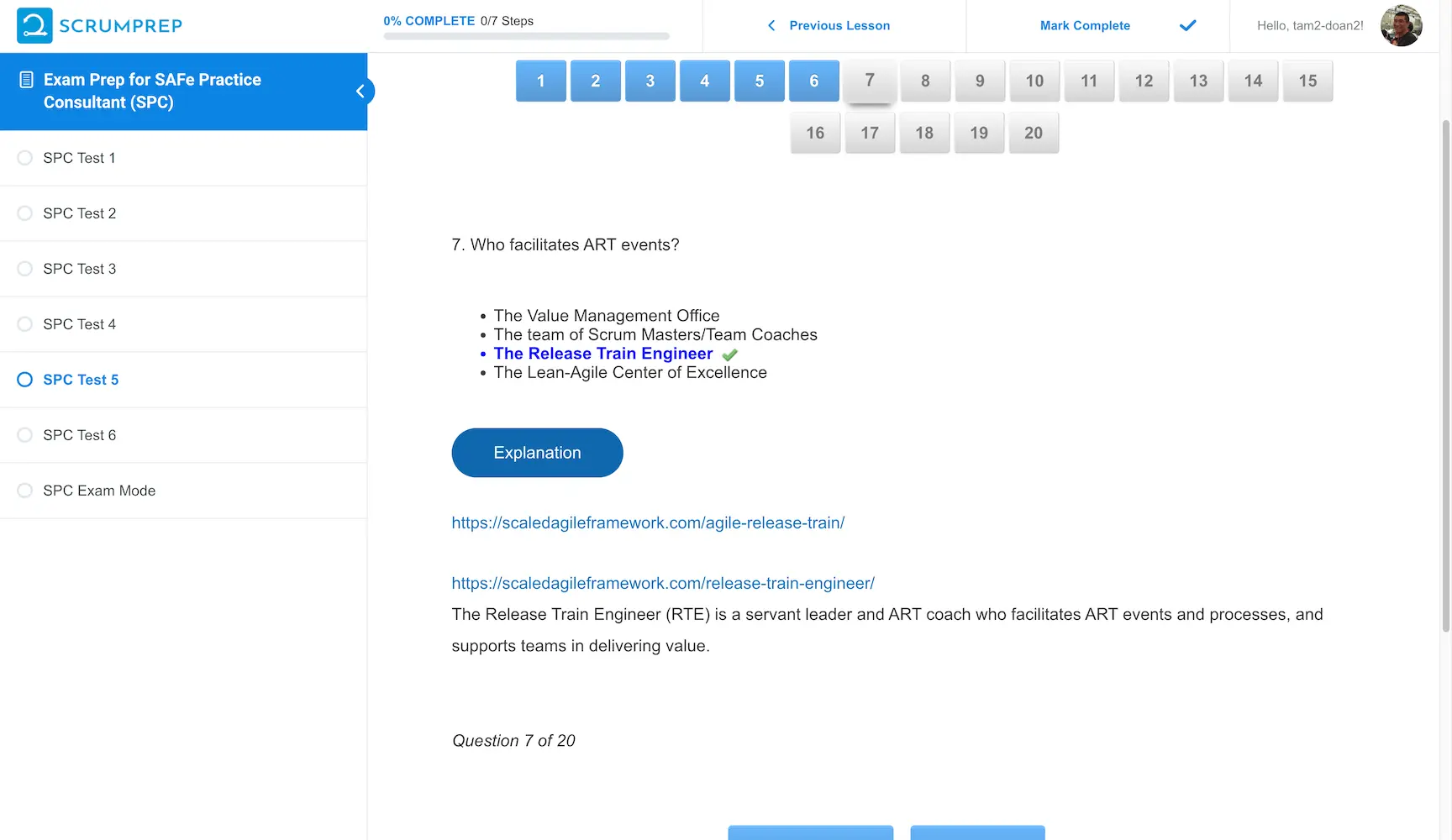
Question 2: Who facilitates ART events? (choose the best answer)
Check answer
Correct answer: C. The Release Train Engineer facilitates ART events such as PI Planning, the ART Sync and Inspect and Adapt. Team-level events are facilitated by the Scrum Master/Team Coach.
Question 3: Which of the following is an area of responsibility for a SAFe Practice Consultant (SPC)? (choose the best answer)
Check answer
Correct answer: A. Coaching flow is one of the SPC’s core areas: helping teams and ARTs see and improve the flow of value, for example with value stream mapping and flow metrics.
Question 4: Which flow metric indicates how many items are currently in the system? (choose the best answer)
Check answer
Correct answer: A. Flow load measures the number of work items currently in progress, the WIP in the system. Flow velocity counts items completed, and flow time measures how long items take.
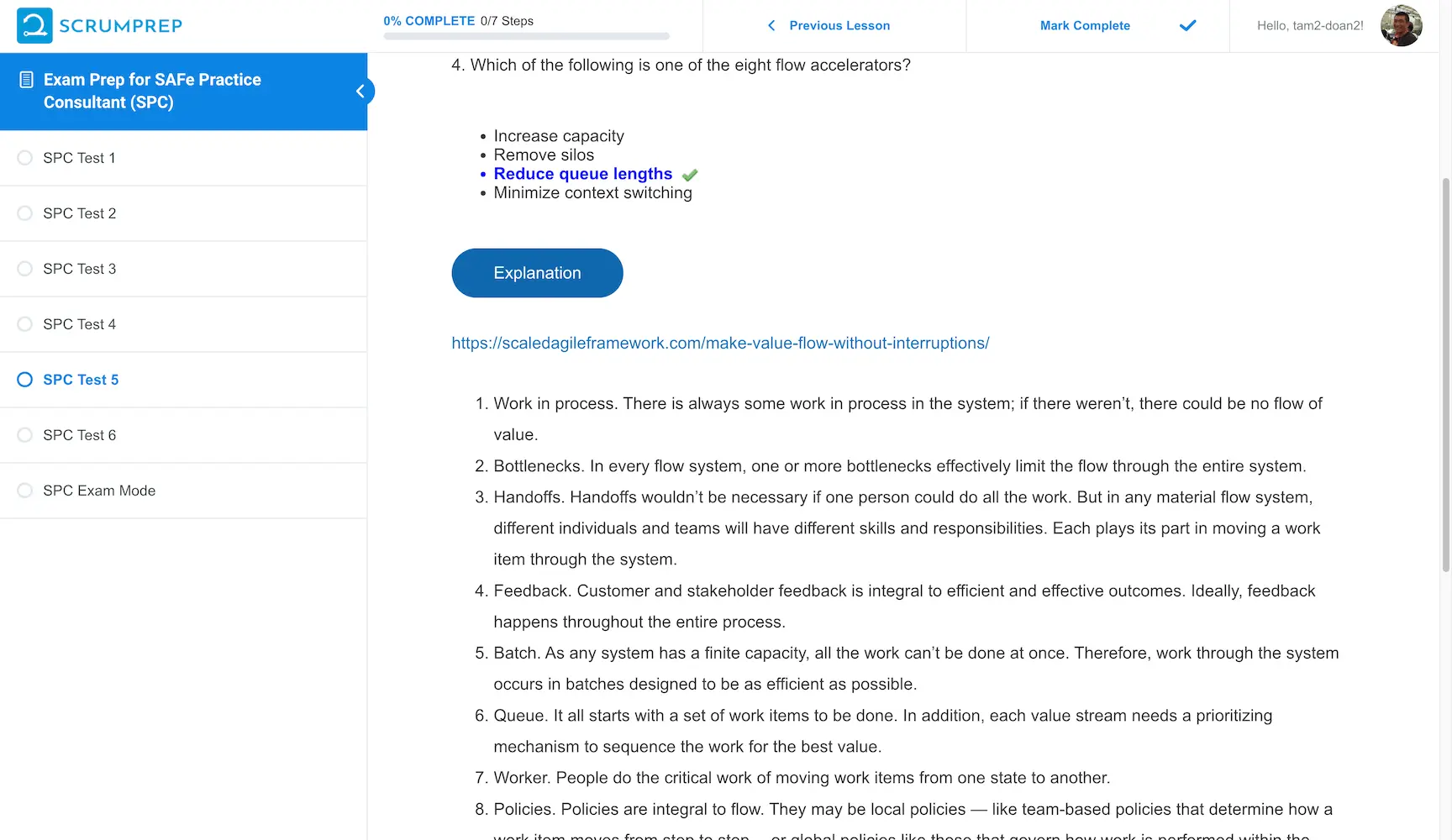
Question 5: Which flow accelerator focuses on the effective throughput of value? (choose the best answer)
Check answer
Correct answer: B. Addressing bottlenecks raises the throughput of the whole system, because the slowest step limits how fast value can flow.
Question 6: The design of an Agile Release Train (ART) should remove what? (choose the best answer)
Check answer
Correct answer: D. An ART is built around the flow of value, so its design should remove functional silos and handoffs that slow that flow.
Question 7: According to John Kotter, what is the first step to successful change? (choose the best answer)
Check answer
Correct answer: B. Kotter’s first step is creating a sense of urgency. SAFe uses it to frame the reason to change before building a guiding coalition and launching ARTs.
Question 8: Who does the final plan review in PI Planning? (choose the best answer)
Check answer
Correct answer: B. On day two of PI Planning, each team presents its final plan, objectives and risks, and the Business Owners review and accept it.
Question 9: What is the recommended size of an effective Agile Release Train (ART)? (choose the best answer)
Check answer
Correct answer: A. SAFe recommends 50 to 125 people per ART: large enough to deliver a solution end to end, small enough to plan and work as one team of teams.
Question 10: What is the final activity on day one of PI Planning? (choose the best answer)
Check answer
Correct answer: C. Day one ends with the management review and problem-solving meeting, where leaders adjust scope, resources and constraints based on the draft plans.
How did you do? The real SAFe SPC exam needs 83%, which is 9 out of 10 here. For more free practice, take the free SAFe SPC quiz. For the full question bank, timed mock exams and an explanation for every question, get the SAFe SPC Exam Prep on this page.
Two ways to prepare: Practice Mode and Mock Exam Mode
- Practice Mode: study at your own pace. Choose how many questions you want in each session, from a short set to all 100+ questions, with no time limit and an in-depth explanation after every answer. Progress saves automatically.
- Mock Exam Mode (Timed Mode): sit a full mock exam that mimics the real one: 60 random questions in 120 minutes, scored at the end. Every attempt draws a new random set.
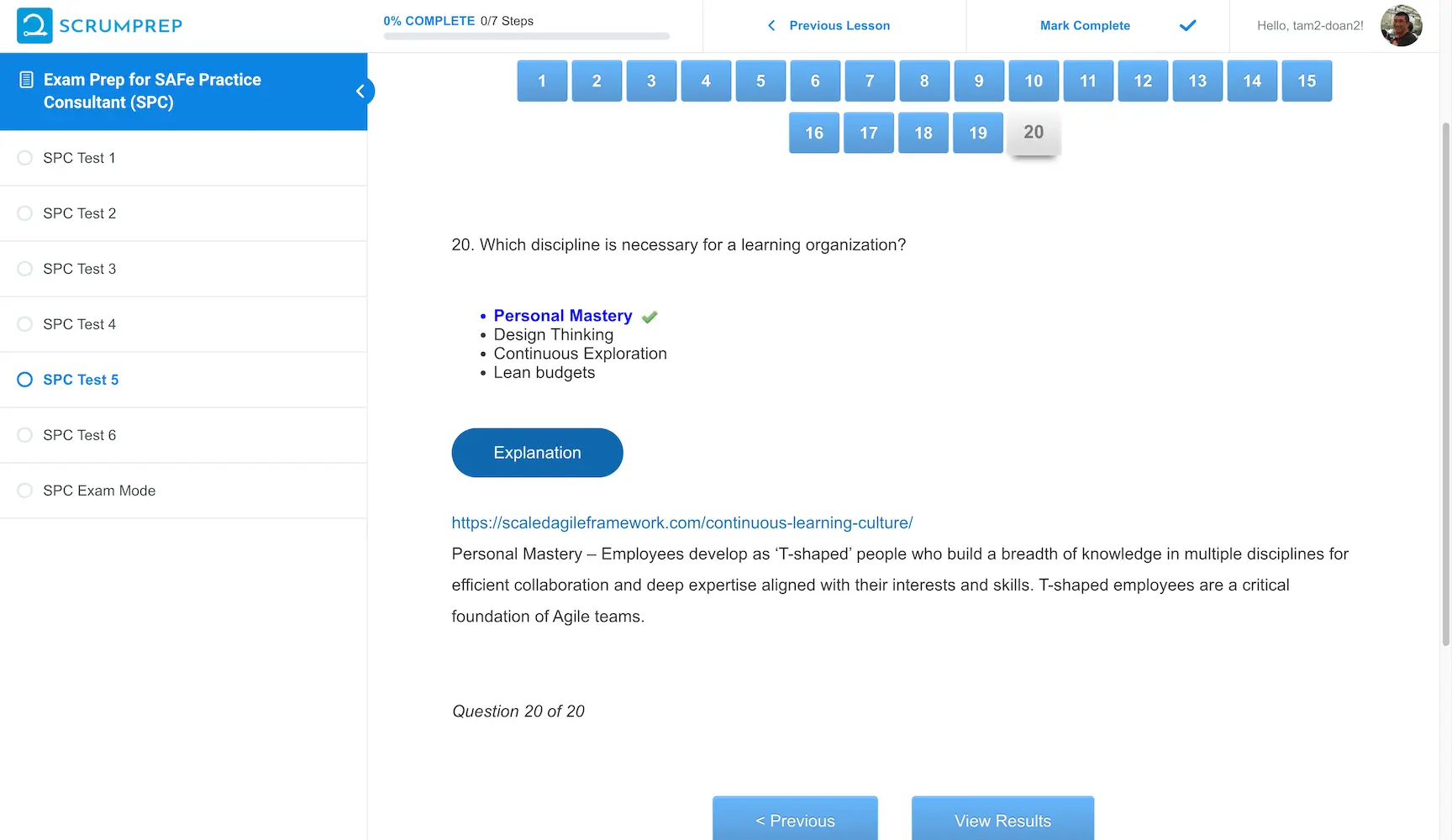
- In-depth explanations: every question comes with a detailed explanation that walks you through what the question is really asking and why the correct answer is right, so you understand the reasoning instead of memorizing answers.
- Benchmarking: compare your scores with other candidates and see which topics need work.
- Lifetime access with updates whenever Scaled Agile changes the exam.
Why ScrumPrep
An SPC retake costs $250, more than most practice tools. Our questions cover the full framework and the Implementation Roadmap, with full explanations. Rated 4.96 out of 5 from more than 4,400 reviews, and backed by our money-back guarantee.
- Trusted since 2016: thousands of candidates have prepared for their certification exams with ScrumPrep.
- Matched to the real exam: questions are written to match the real SAFe SPC exam’s format, difficulty and topics, and checked against the current official exam content.
- Prompt support: questions about an answer or your account? Contact us and we respond promptly.
- Pay once: one payment, no subscription required.
- Study anywhere: practice on your phone, tablet or computer.
SAFe SPC FAQ
Is SPC the same as Implementing SAFe?
Implementing SAFe is the course. SAFe Practice Consultant (SPC) is the certification you get by passing its exam.
Do I have to take the course?
Yes. Scaled Agile only gives exam access to people who attend the matching course, and the first attempt is included in the course fee if you take it within 60 days.
What does a retake cost?
$250 per attempt, compared with $50 for most other SAFe exams.
Does this cover the new AI-Empowered exam?
Yes. Scaled Agile added AI topics to the exam in 2026, about 12% to 14% of the questions, and our bank includes them.
Does SPC expire?
Yes. SAFe certifications are renewed every year through Scaled Agile.
Are these real exam questions or dumps?
Neither. Scaled Agile’s real questions are confidential, and using dumps breaks its exam rules and can cost you the certification. These are original questions written to the same format and topics, each with an in-depth explanation.
What if I don’t pass?
Our money-back guarantee covers you. See the guarantee terms.
Read the free SAFe SPC exam guide, or try the free SAFe SPC quiz first.
Buying for a team? Bulk discounts are available. Contact us for details.

Jackson K. –
It was refreshing to see coaching, metrics, and lean principles woven into the questions.
Harper X. –
The depth of content helped me prepare for both the exam and real transformation work.
Harper W. –
The questions trained me to think like an experienced SPC, not just a test taker.
Mia N. –
The material gave me clarity on value streams, portfolio sync, and SPC responsibilities.
Harper F. –
Each scenario improved my consulting presence and coaching clarity.