


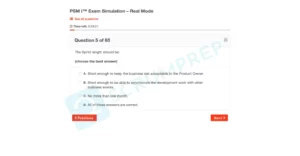
PSM I practice test and exam questions that feel like the real one
The Professional Scrum Master I (PSM I, often searched as PSM 1) is Scrum.org’s foundational certification for Scrum Masters. It is short, timed and strict: you need 85% to pass with about 45 seconds per question, and a multiple-answer question only counts when every choice is right. Our PSM I practice tests are built to remove both risks before you pay for the real attempt.
Try 10 free PSM I sample questions below, no sign-up needed.
PSM I exam at a glance
| Official PSM I exam | ScrumPrep PSM I practice tests | |
|---|---|---|
| Questions | 80 (68 correct to pass) | 480 in the bank; 80 per timed mock |
| Time limit | 60 minutes | 60 minutes in Timed Mode; none in Practice Mode |
| Passing score | 85% | Scored the same way, with a per-topic breakdown |
| Question types | Multiple choice, multiple answer, true/false | Same three types |
| Price | Official exam fee: $200 per attempt, paid to Scrum.org | ScrumPrep practice tests: $29, unlimited attempts. The exam fee is not included. |
| Based on | 2020 Scrum Guide | 2020 Scrum Guide |
Please note: ScrumPrep sells practice tests, not the exam. The $29 covers our PSM I practice tests only. You book and pay for the official PSM I exam separately with Scrum.org.
What the PSM I exam tests
- Scrum theory and empiricism: transparency, inspection and adaptation, and why Scrum is built on them.
- The Scrum Team: the accountabilities of the Scrum Master, Product Owner and Developers, and what self-managing and cross-functional really mean.
- Events: the purpose, timebox and attendees of the Sprint, Sprint Planning, Daily Scrum, Sprint Review and Sprint Retrospective.
- Artifacts and commitments: Product Backlog and Product Goal, Sprint Backlog and Sprint Goal, Increment and Definition of Done.
- The Scrum Master as servant leader: coaching, facilitation and removing impediments, including scaled situations with several teams on one product.
Free PSM I practice test: 10 sample questions
Try these 10 questions from the ScrumPrep PSM I question bank. Open a question, pick your answer, then tap Check answer. Each answer links to a full explanation. Like the real exam, a multiple-answer question only counts when every choice is right.
Question 1: What is the responsibility of the Product Owner in crafting the Sprint Goal? (choose the best answer)
Check answer
Correct answer: B. The Product Owner comes to Sprint Planning with a business objective in mind and works with the Developers to craft the Sprint Goal. The Product Owner neither dictates the goal nor leaves it entirely to the Developers. Read the full explanation
Question 2: The CEO asks the Developers to add a “very important” item to a Sprint that is in progress. What should the Developers do?
(choose the best answer)
Check answer
Correct answer: D. The Developers should discuss the CEO’s item with the rest of the Scrum Team so the team, with the Product Owner, can decide what to do. A senior title does not bypass the Product Owner or the Sprint Goal. Read the full explanation
Question 3: The IT manager asks a Scrum Team for a status report describing the progress throughout the Sprint. The Scrum Team asks the Scrum Master for advice. The Scrum Master should: (choose the best answer)
Check answer
Correct answer: B. The Scrum Master should explain to the IT manager that progress in Scrum is shown by inspecting a working Increment at the Sprint Review. A separate status report is not how Scrum makes progress transparent. Read the full explanation
Question 4: The Scrum Master observes the Product Owner struggling with ordering the Product Backlog. What is an appropriate action for the Scrum Master to take? (choose the best answer)
Check answer
Correct answer: C. The Scrum Master should help the Product Owner see that the purpose of ordering the Product Backlog is to maximize value. Handing the job to the Developers, ordering by speed or extending the Sprint all miss the point. Read the full explanation
Question 5: When multiple Scrum Teams are working on a single product, what best describes the Definition of Done? (choose the best answer)
Check answer
Correct answer: D. When several Scrum Teams work on one product, they must mutually define and comply with the same Definition of Done. Separate definitions, later reconciliation or a definition set by Scrum Masters do not produce one integrated Increment. Read the full explanation
Question 6: Who determines when it is appropriate to update the Sprint Backlog during a Sprint? (choose the best answer)
Check answer
Correct answer: B. The Developers decide when to update the Sprint Backlog during the Sprint. The Product Owner can clarify and negotiate scope, but the plan belongs to the people doing the work. Read the full explanation
Question 7: What does it mean for a Scrum Team to be cross-functional? (choose the best answer)
Check answer
Correct answer: A. Cross-functional means the Scrum Team members together have all the skills needed to create value each Sprint. It is not about job titles, and it does not depend on people outside the team. Read the full explanation
Question 8: One of the Scrum events is the Daily Scrum. What are two intended outcomes of the Daily Scrum?
Check answer
Correct answer: A and B. The Daily Scrum should surface impediments to the Sprint Goal and give the Developers a shared view of the most important work to do next. It is not a status report for the Scrum Master, management or stakeholders. Read the full explanation
Question 9: At the end of a Sprint, a Product Backlog item worked on during the Sprint does not meet the Definition of Done. What two things should happen with the undone Product Backlog item? (choose the best two answers)
Check answer
Correct answer: A and C. An item that does not meet the Definition of Done goes back to the Product Backlog for the Product Owner to decide on, and it is not included in the Increment. It cannot be released or counted as partly done. Read the full explanation
Question 10: True or False: The Product Owner makes sure the Developers select enough from the Product Backlog for a Sprint to satisfy the stakeholders.
Check answer
Correct answer: B. False. The Developers decide how much to select from the Product Backlog for a Sprint, and the goal is a valuable, achievable Sprint, not satisfying stakeholders with volume. Read the full explanation
How did you do? The real PSM I exam needs 85%, which is 9 out of 10 here. For more free practice, take the free PSM I quiz. For the full question bank, timed mock exams and an explanation for every question, get the PSM I Exam Prep on this page.
Two ways to prepare: Practice Mode and Mock Exam Mode
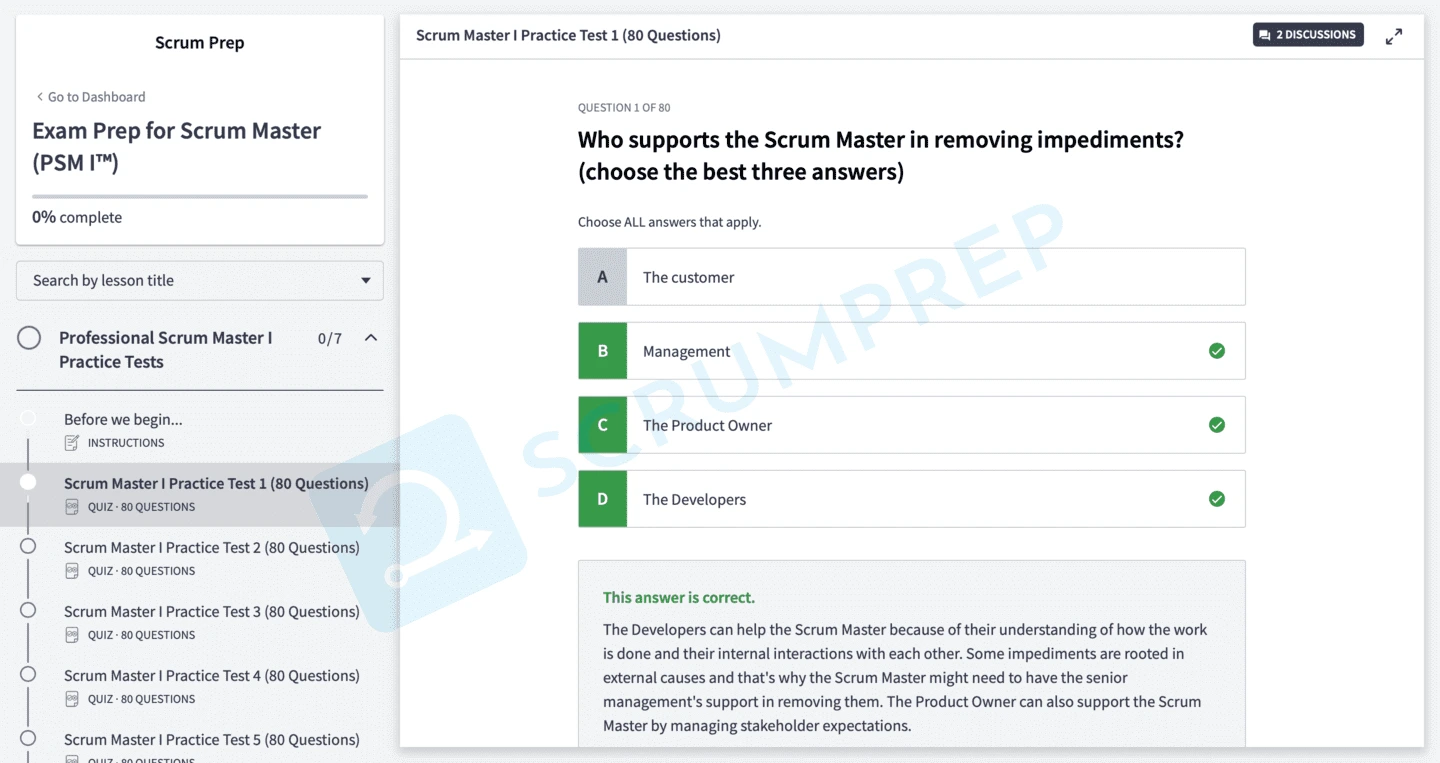
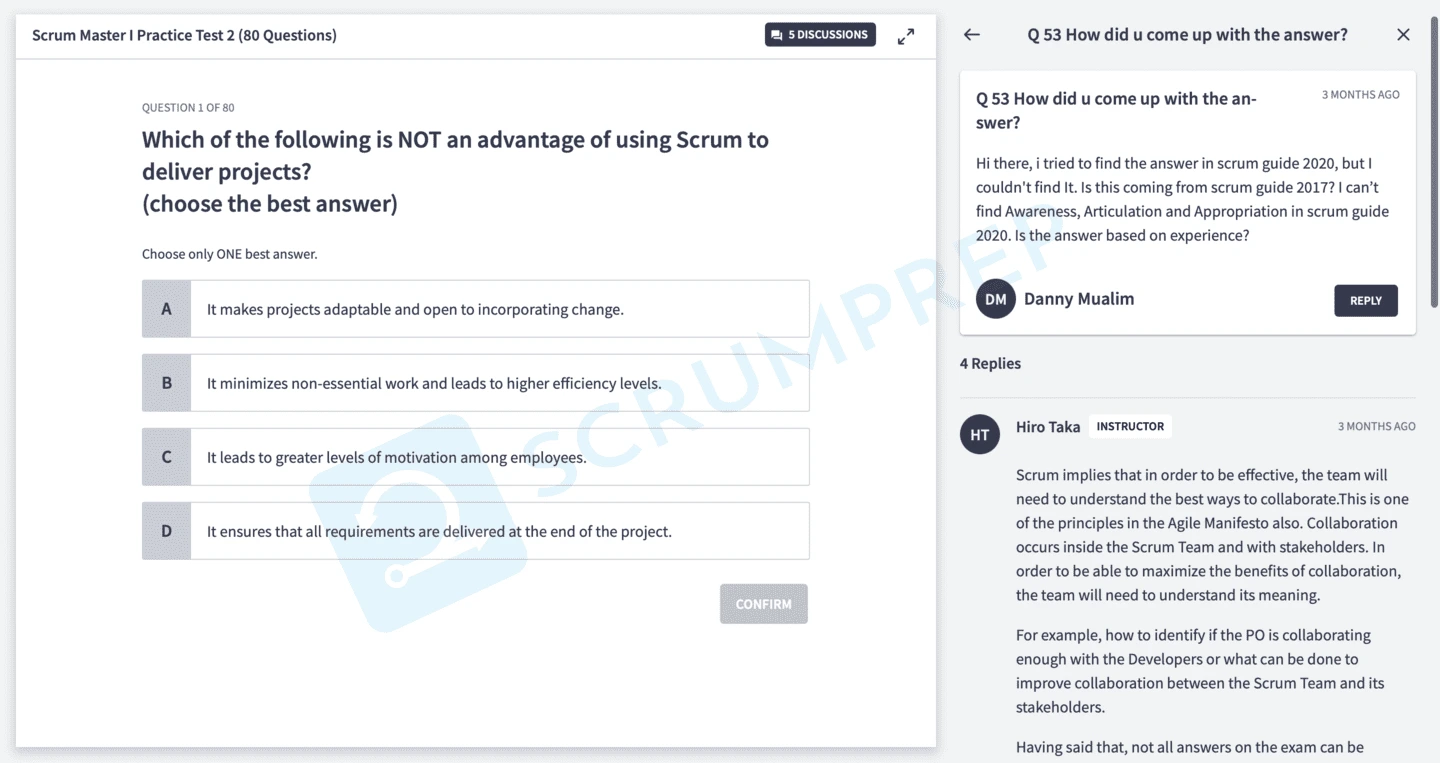
- Practice Mode: study at your own pace. Choose how many questions you want in each session, from a short set to all 480 questions, with no time limit and an in-depth explanation after every answer. Progress saves automatically.
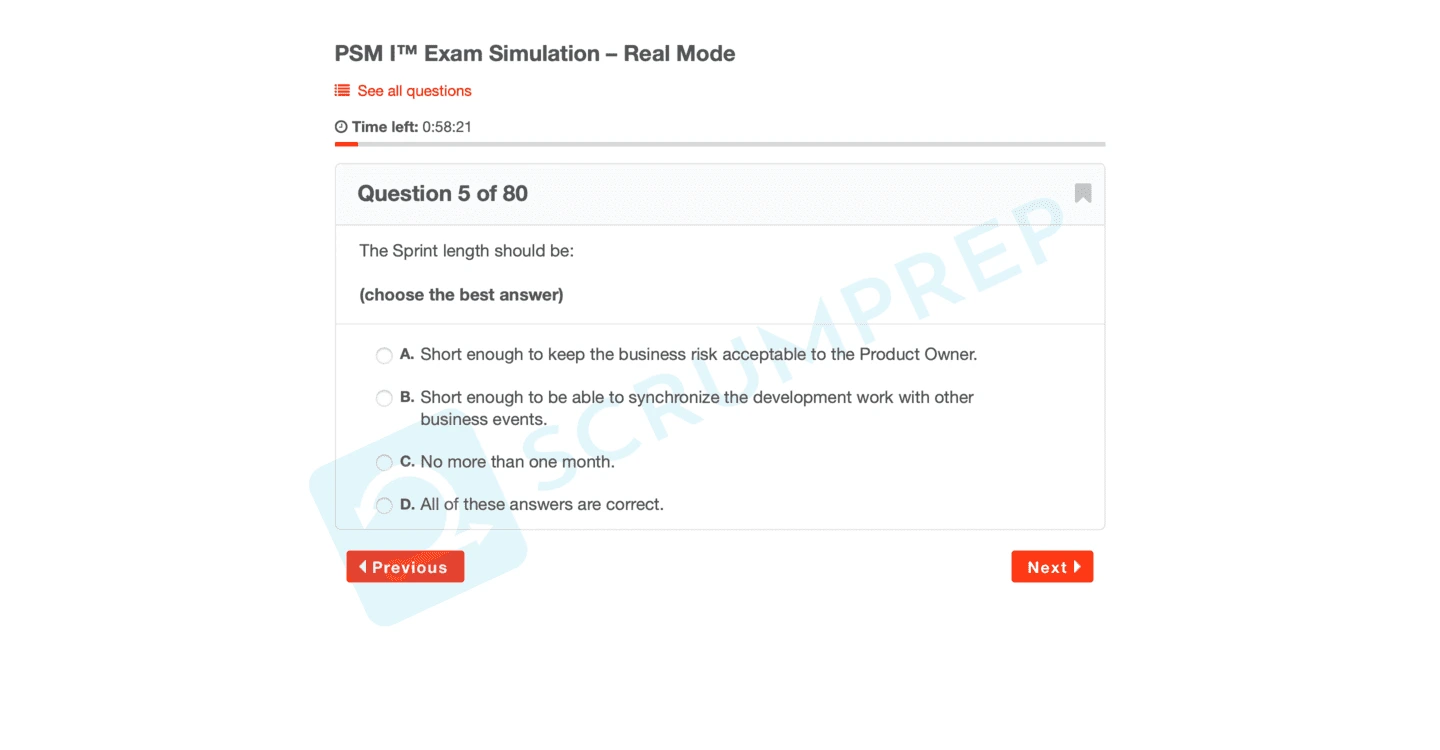
- Mock Exam Mode (Timed Mode): sit a full mock exam that mimics the real one: 80 random questions in 60 minutes, scored at the end. Every attempt draws a new random set.
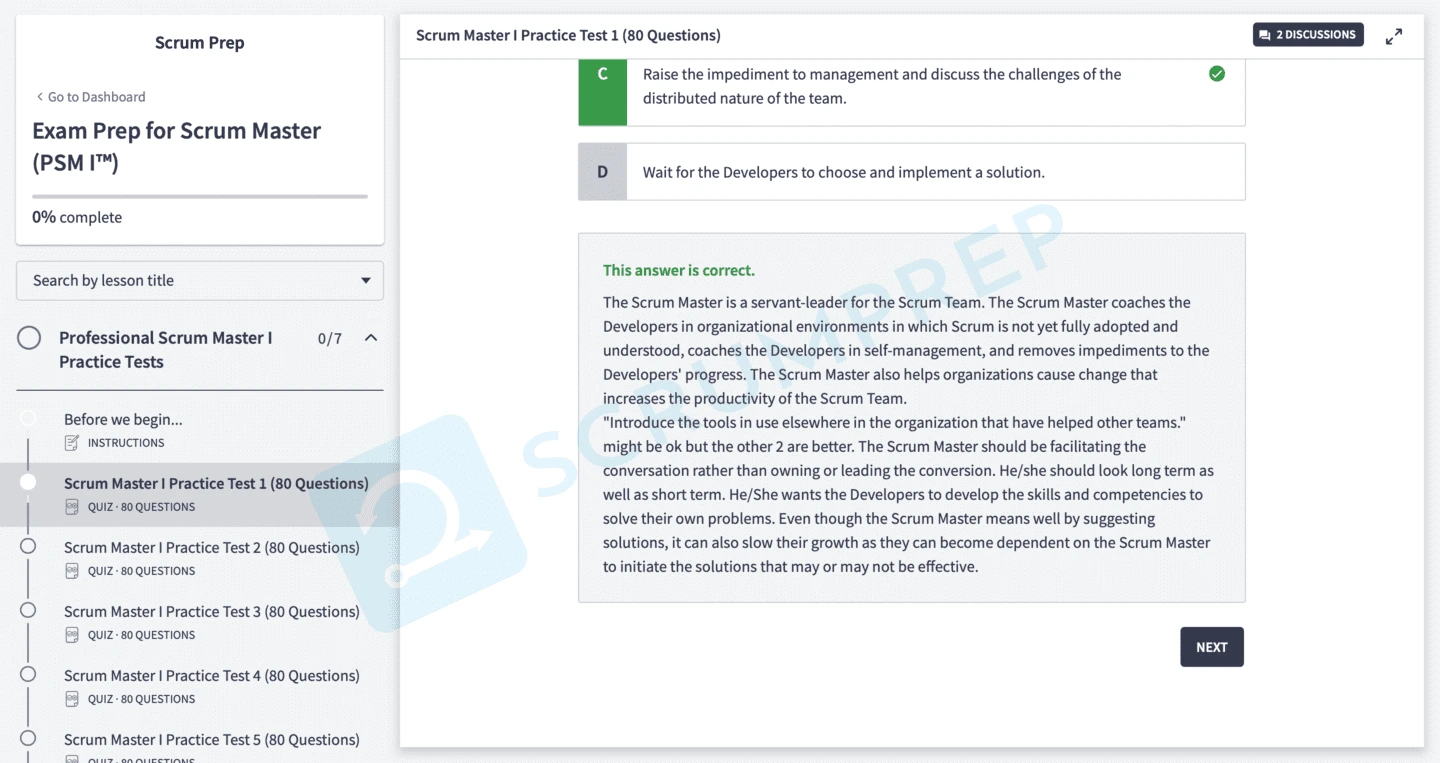
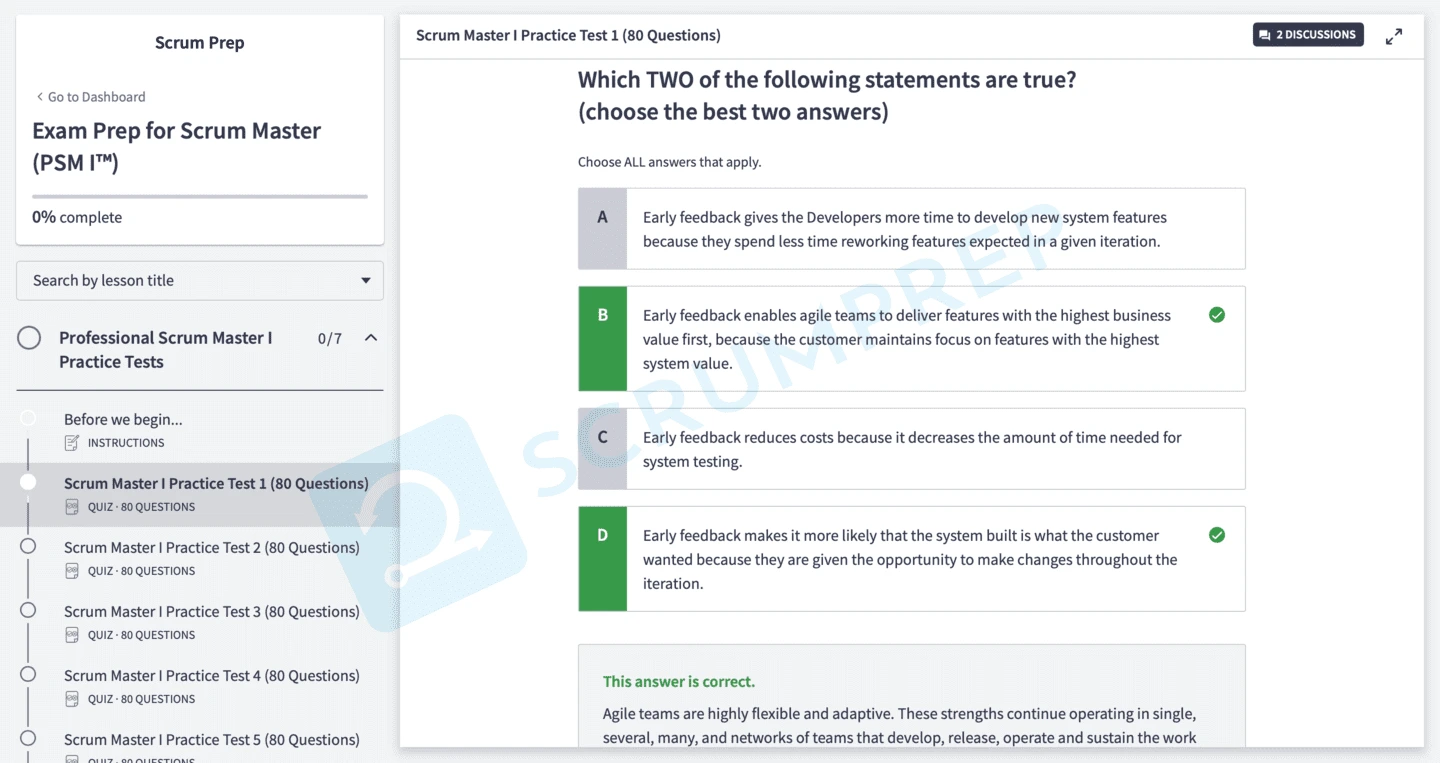
- In-depth explanations: every question comes with a detailed explanation that walks you through what the question is really asking and why the correct answer is right, so you understand the reasoning instead of memorizing answers.
- Benchmarking: compare your scores with other candidates and see which topics need work.
- Lifetime access with updates whenever Scrum.org changes the exam.
Why ScrumPrep
Scrum.org’s free Scrum Open assessment is a good first check, but each attempt is only 30 questions and they repeat quickly. Our bank has 480, and every question explains why each option is right or wrong. Rated 4.9 out of 5 from more than 5,000 reviews, and backed by a 100% money-back guarantee.
- Trusted since 2016: thousands of candidates have prepared for their certification exams with ScrumPrep.
- Matched to the real exam: questions are written to match the real PSM I exam’s format, difficulty and topics, and checked against the current official exam content.
- Prompt support: questions about an answer or your account? Contact us and we respond promptly.
- Pay once: one payment, no subscription required.
- Study anywhere: practice on your phone, tablet or computer.
PSM I FAQ
Is PSM I the same as PSM 1?
Yes. Scrum.org writes it with a Roman numeral, but it is the same exam.
How hard is the PSM I?
The questions are rarely tricky on their own, but the 85% bar and 45 seconds per question leave little room for error. Candidates who consistently score 95% or more in our timed mocks are ready.
Do I need to take a course first?
No. Scrum.org does not require a course for PSM I. Many candidates pass with the Scrum Guide and practice tests alone.
Does PSM I expire?
No. The certification is for life and has no renewal fee.
Are these real exam questions or dumps?
Neither. Scrum.org’s real questions are confidential, and dumps break its rules and can cost you the certification. These are original questions written to the same format and topics, each with an in-depth explanation.
What if I don’t pass?
You are covered by our money-back guarantee. See the guarantee terms.
Read the free PSM I exam guide, or try the free PSM I quiz first.
Buying for a team? Bulk discounts are available. Contact us for details.


James D. –
Increased my exam performance.
Mason O. –
These practice exams were my trusted companions on my path to PSM I certification. The questions were thought-provoking, and the explanations were thorough. They helped me earn the certification and equipped me with a deeper understanding of Scrum.
Elijah U. –
These practice exams were instrumental in my PSM I exam success. The questions were challenging and comprehensive, mirroring the actual test environment. The detailed explanations after each question deepened my understanding of Scrum principles and helped me pass with confidence.
Chloe R. –
A reliable study companion.
Emma S. –
The PSM I practice exams are a game-changer.
Ava T. –
I consider these practice exams my PSM I exam secret weapon. The questions were tough but relevant, and the explanations were enlightening. They made the difference between passing and excelling in the exam.
Ethan S. –
I’m impressed by the depth of knowledge in this PSM I course.
Mason V. –
Passed with ease.
William G. –
These practice exams were instrumental in my PSM I exam success. The questions were challenging and comprehensive, mirroring the actual test environment. The detailed explanations after each question deepened my understanding of Scrum principles and helped me pass with confidence.
Mia P. –
A valuable addition to my study routine.