

PSF Skills practice test for Scrum facilitation
The Professional Scrum Facilitation Skills (PSF Skills, often searched as PSF) certification from Scrum.org checks that you can facilitate Scrum events and other team conversations well: choosing the right technique, keeping things neutral and helping a group reach a decision. It is a short exam, 20 questions in 30 minutes. Our PSF Skills practice tests drill the principles and the techniques.
PSF Skills exam at a glance
| Real PSF Skills assessment | ScrumPrep PSF Skills practice tests | |
|---|---|---|
| Questions | 20 | 60+ in the bank; 20 per timed mock |
| Time limit | 30 minutes | 30 minutes in Timed Mode; none in Practice Mode |
| Passing score | 85% | Scored the same way, with a per-topic breakdown |
| Question types | Multiple choice | Multiple choice, multiple answer, true/false |
| Fee | $200 per attempt, paid to Scrum.org | $29, unlimited attempts |
| Based on | 2020 Scrum Guide and Scrum.org’s facilitation material | The same |
What the PSF Skills exam tests
- Facilitation principles: neutrality, clear purpose, inclusion and helping groups decide.
- Facilitation techniques: Liberating Structures and other methods, and when each fits.
- Scrum events: facilitating Sprint Planning, the Daily Scrum, the Sprint Review and the Retrospective.
- Scrum values and the Scrum Team: how facilitation supports self-management.
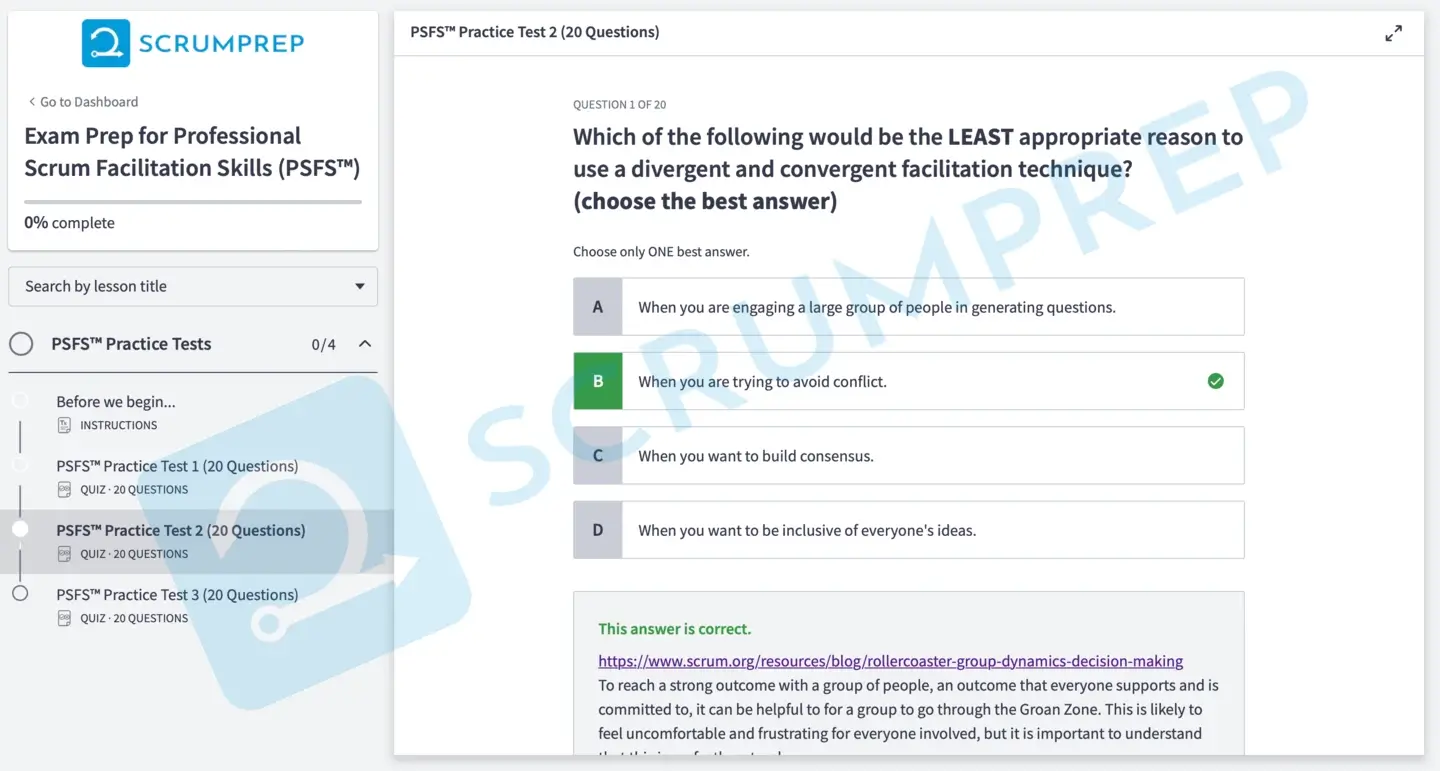
Sample PSF Skills exam question
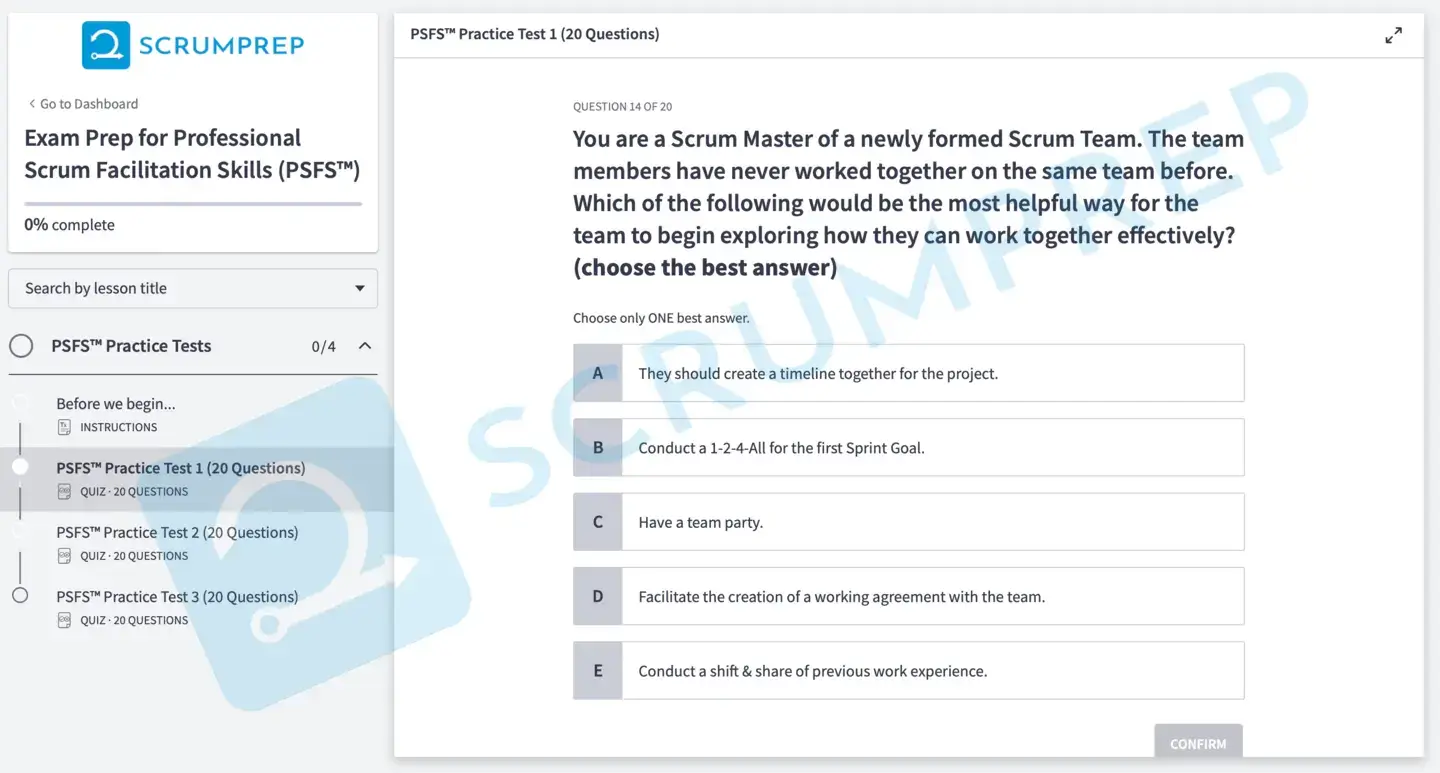
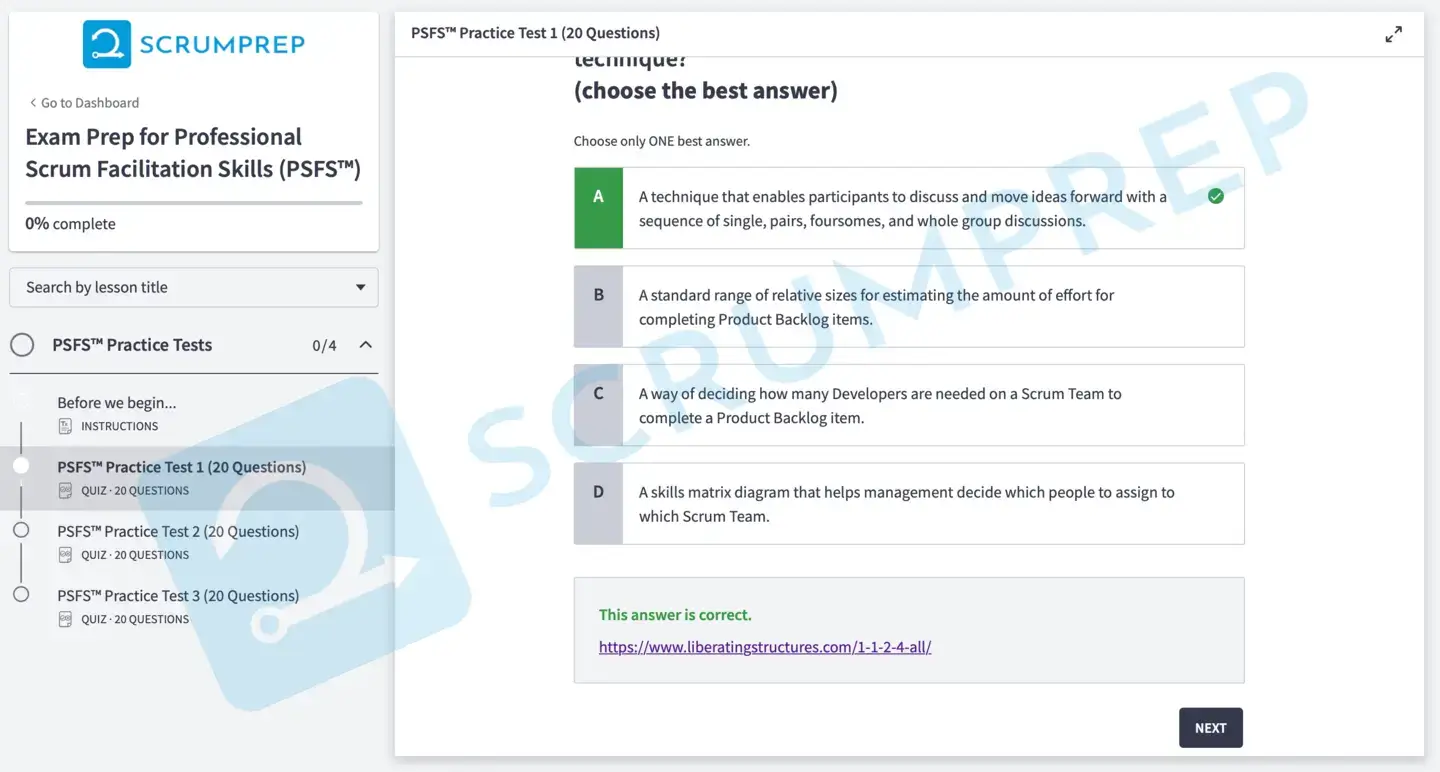
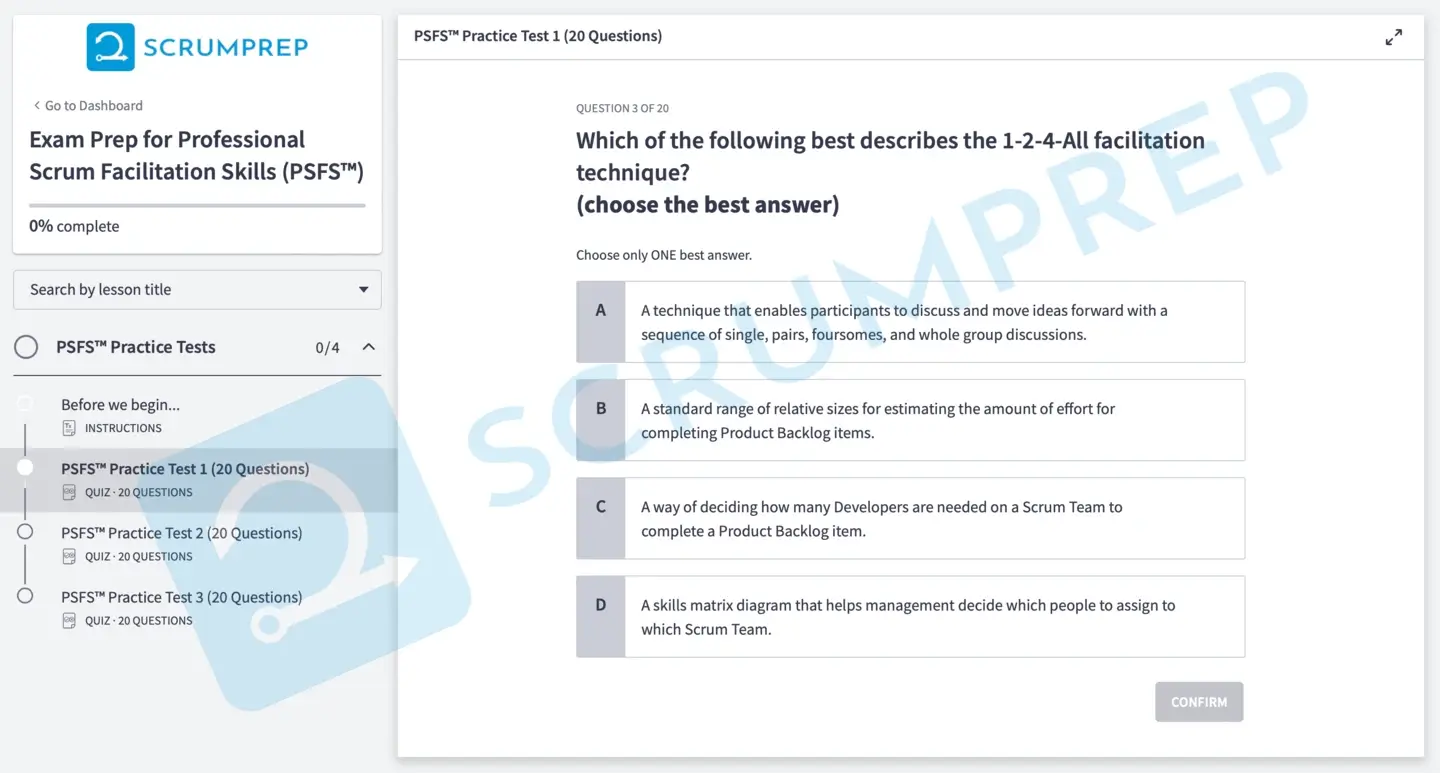
During a Sprint Retrospective, two people dominate the conversation. Which approach best helps the facilitator hear from everyone?
- The Scrum Master summarizes the issues and decides the actions.
- Use a structure such as 1-2-4-All, where people think alone, then in pairs, then in fours, before the whole group.
- End the Retrospective early.
- Ask the quiet people to speak one at a time in front of the group.
Answer: 2. Structures like 1-2-4-All give everyone time to think and a safe place to speak before the group discusses, so ideas do not depend on who talks loudest. Every question in our bank explains its answer like this.
How the PSF Skills practice tests work
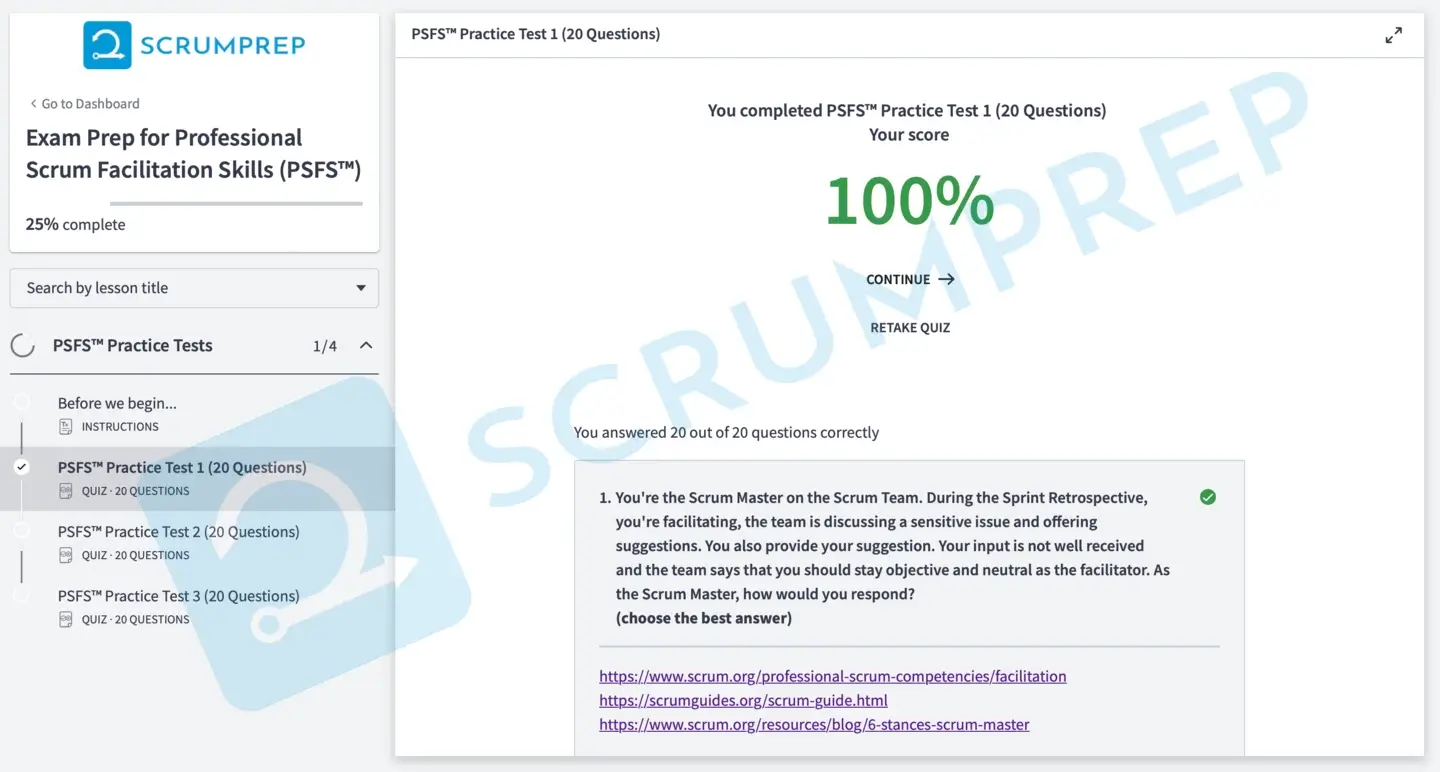
- Practice Mode: all 60+ questions, no time limit, with feedback after each answer. Progress saves automatically.
- Timed Mode: 20 random questions in 30 minutes, scored at the end, just like the real assessment.
- Custom test length: shorter sets for short study sessions.
- Benchmarking: compare your scores with other candidates and see which topics need work.
- Lifetime access with updates whenever Scrum.org changes the exam.
Why ScrumPrep
Facilitation is hard to learn from a guide alone. Our questions put you in real event situations and explain the best technique for each. Rated 4.97 out of 5 from more than 4,600 reviews, and backed by our money-back guarantee.
PSF Skills FAQ
Is PSF the same as PSF Skills? Yes. Scrum.org’s full name is Professional Scrum Facilitation Skills.
Is a course required? No. Scrum.org’s Professional Scrum Facilitation Skills course is recommended but optional.
Does PSF Skills expire? No. It is a lifetime certification with no renewal fee.
Are these real exam questions or dumps? Neither. Scrum.org’s real questions are confidential, and dumps break its rules and can cost you the certification. These are original questions written to the same format and topics, each with an explanation.
What if I don’t pass? Our money-back guarantee covers you. See the guarantee terms.
Read the free PSF Skills exam guide, or try the free PSF Skills quiz first.
Buying for a team? Bulk discounts are available. Contact us for details.


Emily T. –
The prep was challenging in the best way—it made me a better facilitator.
Mia F. –
Practicing helped me create more flow and focus during Daily Scrums.
Henry N. –
This resource made me a better listener and space-holder for team dialogue.
Sophia H. –
These questions helped me build better habits around reflection and feedback.
Mia K. –
I became more confident asking powerful questions instead of giving advice.
Sophia K. –
I now feel more comfortable using silence and reflection as facilitation tools.
Olivia N. –
The practice helped me recognize the difference between facilitating and managing.
Benjamin Y. –
Each question helped me reflect on how I show up as a facilitator.
Chloe E. –
I learned how to enable participation from quieter team members.
Sophia S. –
This resource taught me how to structure Sprint Planning for better engagement.