




PMI-ACP practice exam and test questions
The PMI Agile Certified Practitioner (PMI-ACP) checks that you can apply agile approaches in real projects, whatever the framework. The current exam has 120 questions in 180 minutes, organized around four domains: Mindset, Leadership, Product and Delivery. Questions are mostly scenarios, so you need to recognize the most agile response. Our PMI-ACP practice exams are written for the current four-domain exam and build that habit.
Try 10 free PMI-ACP sample questions below, no sign-up needed.
PMI-ACP exam at a glance
| Official PMI-ACP exam | ScrumPrep PMI-ACP practice tests | |
|---|---|---|
| Questions | 120 (100 scored, 20 unscored) | 380 in the bank; 120 per timed mock |
| Time limit | 180 minutes, with a 10-minute break | 180 minutes in Timed Mode; none in Practice Mode |
| Question types | Multiple choice | Multiple choice |
| Price | Official exam fee: Set by PMI and paid to PMI; lower for PMI members | ScrumPrep practice tests: $29, unlimited attempts. The exam fee is not included. |
| Based on | PMI-ACP Examination Content Outline | The same four domains |
Please note: ScrumPrep sells practice tests, not the exam. The $29 covers our PMI-ACP practice tests only. You book and pay for the official PMI-ACP exam separately with PMI.
What the PMI-ACP exam tests
- Mindset: agile values and principles, and choosing the right approach.
- Leadership: servant leadership, team empowerment and collaboration.
- Product: value, backlog management and stakeholder feedback.
- Delivery: planning, flow, metrics, quality and continuous improvement.
Free PMI-ACP practice test: 10 sample questions
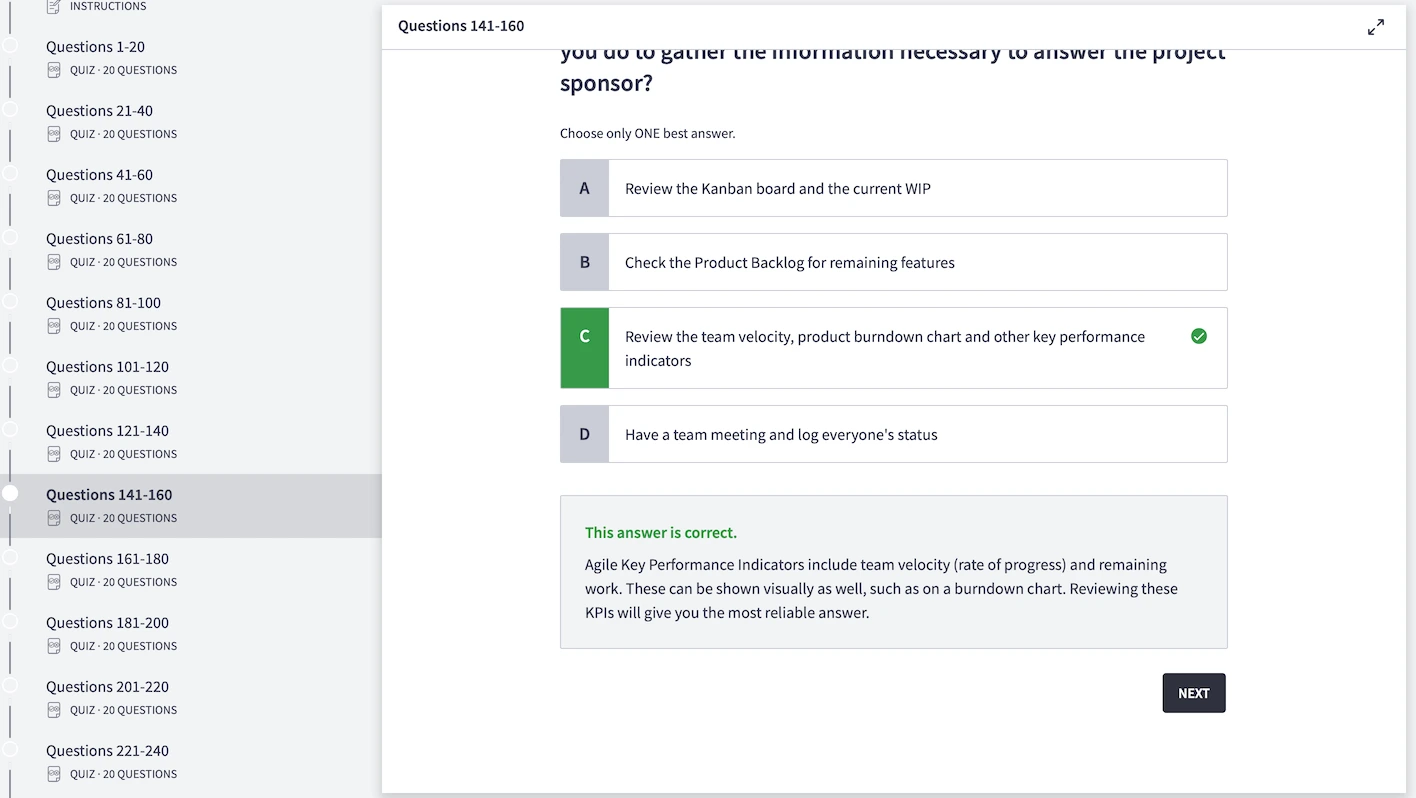
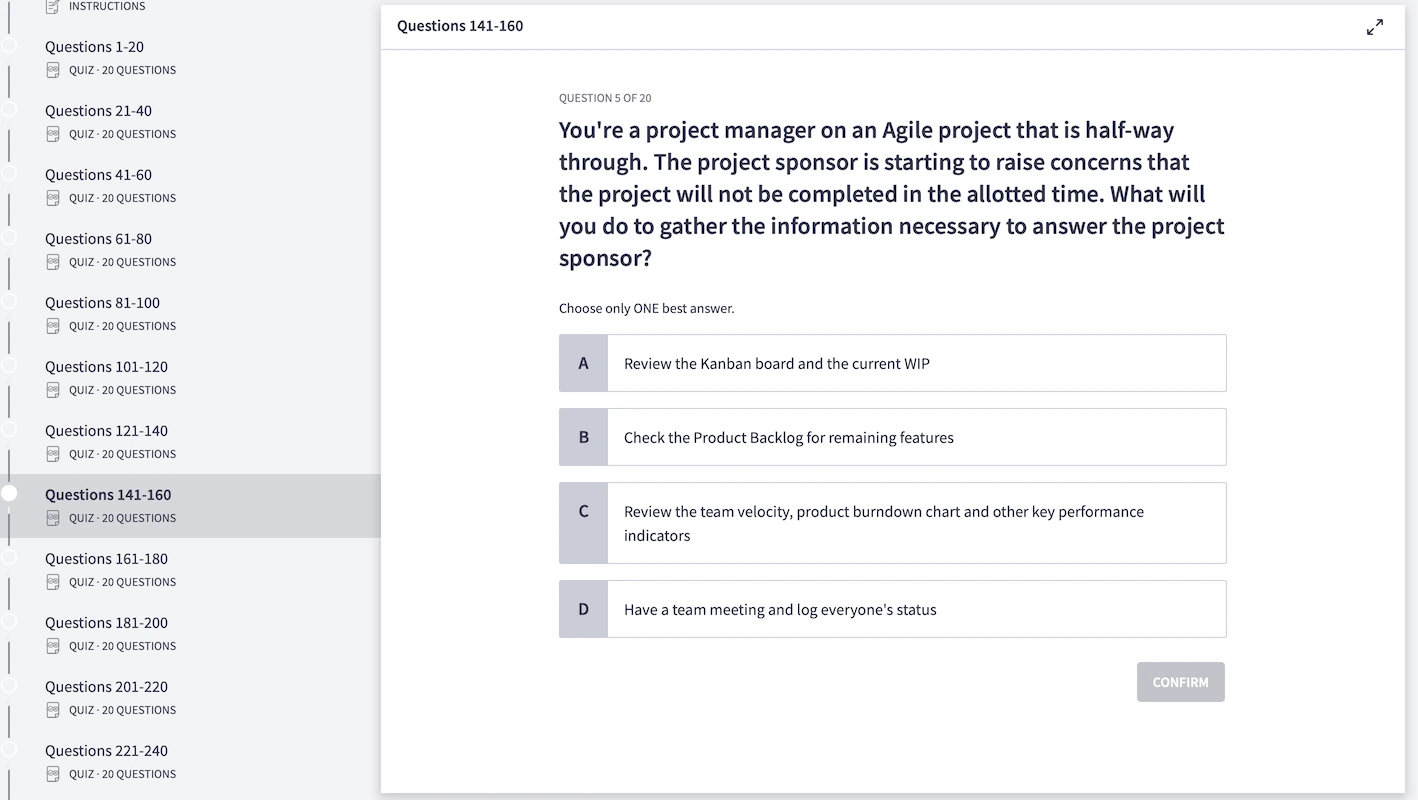
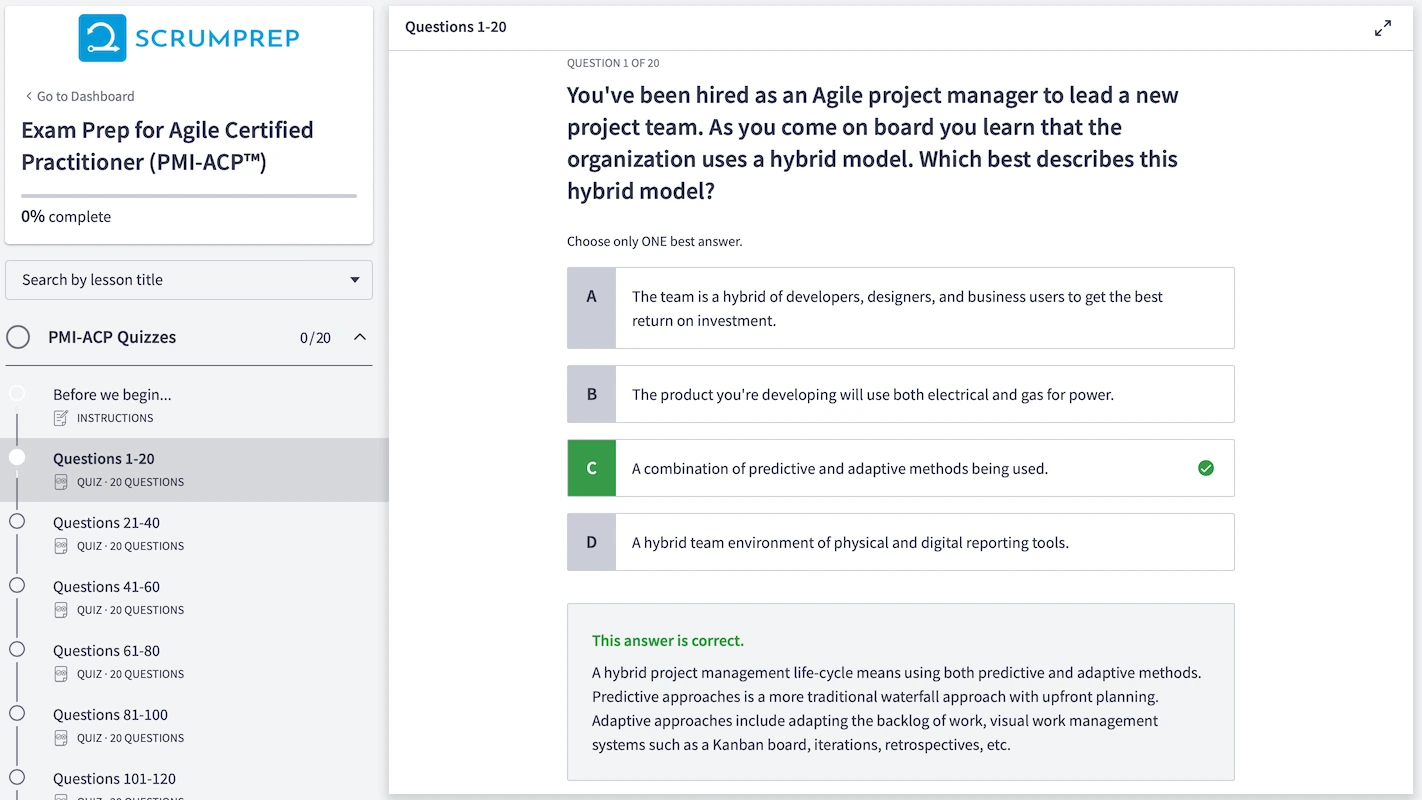
Try these 10 questions from the ScrumPrep PMI-ACP question bank. Open a question, pick your answer, then tap Check answer to see the correct answer and why.
Question 1: A team assigned 3 Story Points to a work item. The manager wanted to know how this can corelate to the time required to complete it. How should the team respond? (choose the best answer)
Check answer
Correct answer: C. Story points estimate relative effort, not hours or days. Over time the team’s velocity shows how many points it completes per iteration, which is how points relate to time.
Question 2: During testing of a product, the tester and the developer disagreed on the usability of a particular feature. Who should be able to resolve this confusion regarding functionality? (choose the best answer)
Check answer
Correct answer: B. The Product Owner decides what the product should do and how it should work for users, so questions about expected functionality go to the Product Owner.
Question 3: Where would you most likely find epics in the Product Backlog? (choose the best answer)
Check answer
Correct answer: D. Epics are large items that have not been broken down yet. Lower-priority work stays large, so epics usually sit at or near the bottom of the backlog until they move up and get split.
Question 4: An Agile team for which you are the project manager has determined several key features to deliver to the customer. How should these tasks be addressed by the team? (choose the best answer)
Check answer
Correct answer: A. Agile delivers value in small, complete increments in priority order. Each feature should be done and tested when delivered, not rushed out unfinished or saved for the end.
Question 5: In 2001, a group of individuals, representing different agile practices and frameworks, agreed on a common set of values and principles which become known as the ‘Agile Manifesto’. Which of the following is one of the core values? (choose the best answer)
Check answer
Correct answer: D. “Responding to change over following a plan” is one of the four values of the Agile Manifesto. The other options are not in the Manifesto.
Question 6: The organization you’re working with has decided to move towards an agile approach and way of working. Which of the following would best describe an agile project life-cycle? (choose the best answer)
Check answer
Correct answer: A. An agile life cycle is both iterative and incremental: work is refined through feedback (iterative) and delivered in small usable pieces (incremental).
Question 7: Over past several iterations, the amount of work your Agile team was able to complete ranged between 25 to 35 units of work per iteration. Which of the following actions would be valid? (choose the best answer)
Check answer
Correct answer: B. Basing the work limit on the team’s actual range supports a sustainable pace, and the team adjusts it as things change. Pushing for more or adding people does not fix the plan.
Question 8: Which of the following is NOT a principle defined in the Agile Manifesto? (choose the best answer)
Check answer
Correct answer: B. Meeting deadlines at all costs is not an Agile Manifesto principle. Agile focuses on delivering value, which can mean changing scope rather than forcing a date.
Question 9: At a walkthrough, a stakeholder, end user, and the development team identify significant new functionality required for the proposed solution to be effective. What is the next step? (choose the best answer)
Check answer
Correct answer: C. New functionality goes into the Product Backlog, where the Product Owner orders it and the team estimates it later. It is not added to the current iteration.
Question 10: Osmotic communication is most likely to occur in which of the following team environments? (choose the best answer)
Check answer
Correct answer: D. Osmotic communication is picking up useful information by overhearing teammates nearby. It needs a co-located team; distributed teams cannot have it.
How did you do? PMI does not publish the PMI-ACP pass mark, so aim to get these right consistently before you book. For more free practice, take the free PMI-ACP quiz. For the full question bank, timed mock exams and an explanation for every question, get the PMI-ACP Exam Prep on this page.
Two ways to prepare: Practice Mode and Mock Exam Mode
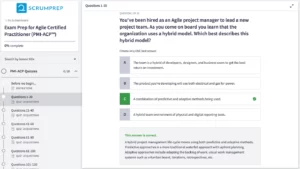
- Practice Mode: study at your own pace. Choose how many questions you want in each session, from a short set to all 380 questions, with no time limit and an in-depth explanation after every answer. Progress saves automatically.
- Mock Exam Mode (Timed Mode): sit a full mock exam that mimics the real one: 120 random questions in 180 minutes, scored at the end. Every attempt draws a new random set.
- In-depth explanations: every question comes with a detailed explanation that walks you through what the question is really asking and why the correct answer is right, so you understand the reasoning instead of memorizing answers.
- Benchmarking: compare your scores with other candidates and see which topics need work.
- Lifetime access with updates whenever PMI changes the exam.
Why ScrumPrep
Our 380 questions are scenario-based, like the real exam, with a full explanation for each. Rated 5.00 out of 5 from more than 4,400 reviews, and backed by our money-back guarantee.
- Trusted since 2016: thousands of candidates have prepared for their certification exams with ScrumPrep.
- Matched to the real exam: questions are written to match the real PMI-ACP exam’s format, difficulty and topics, and checked against the current official exam content.
- Prompt support: questions about an answer or your account? Contact us and we respond promptly.
- Pay once: one payment, no subscription required.
- Study anywhere: practice on your phone, tablet or computer.
PMI-ACP FAQ
Who can take the PMI-ACP?
PMI requires agile training and project experience. Check the PMI-ACP handbook for the current requirements.
Is PMI-ACP tied to Scrum?
No. It covers agile in general, including Scrum, Kanban, Lean and XP.
How long is PMI-ACP valid?
Three years. You renew it by earning 30 professional development units in agile topics.
Are these real exam questions or dumps?
Neither. PMI’s real questions are confidential, and using dumps breaks its exam rules and can cost you the certification. These are original questions written to the same format and topics, each with an in-depth explanation.
What if I don’t pass?
Our money-back guarantee covers you. See the guarantee terms.
Read the free PMI-ACP exam guide, or try the free PMI-ACP quiz first.
Buying for a team? Bulk discounts are available. Contact us for details.

Stephanie L. –
The convenience of online access made these practice exams stand out.
Jennifer H. –
I’ve recommended these practice tests to my colleagues, and they’ve found them just as beneficial.
Elizabeth H. –
These practice exams are a valuable addition to any Agile practitioner’s toolkit.
Christopher H. –
These practice exams are a treasure trove of Agile knowledge. The online access allowed me to study conveniently, and the questions covered a wide spectrum of Agile principles. What truly sets these exams apart is the detailed explanations provided after each question. They clarified complex concepts and deepened my understanding of Agile practices. I wholeheartedly recommend these practice exams to anyone pursuing Agile certifications.
Katherine P. –
I found the practice exams to be a cost-effective way to solidify my Agile knowledge.
Kenneth L. –
The explanations provided with each question are insightful.
William –
The practice exams are a confidence booster for the real exam.
David C. –
I love the detailed explanations; they helped me understand the ‘why’ behind each answer.
Christopher S. –
These practice exams provide a comprehensive overview of Agile principles.
Joshua M. –
The practice tests are well-structured, making it easy to focus on specific topics.