


PAL I practice test and exam questions for agile leaders
The Professional Agile Leadership I (PAL I, often searched as PAL 1 or PAL-I) is Scrum.org’s certification for managers, executives and anyone who leads people working with agility. It checks whether you understand why agility matters to an organization and how a leader’s behavior helps or blocks it. Expect questions about a manager who wants status reports, a team that is not trusted to self-manage, or an executive who asks for fixed scope and dates. Our PAL I practice tests train you to spot the leader’s best move.
PAL I exam at a glance
| Official PAL I exam | ScrumPrep PAL I practice tests | |
|---|---|---|
| Questions | 36 | 70+ in the bank; 36 per timed mock |
| Time limit | 60 minutes | 60 minutes in Timed Mode; none in Practice Mode |
| Passing score | 85% | Scored the same way, with a per-topic breakdown |
| Question types | Multiple choice, multiple answer, true/false | Same three types |
| Price | Official exam fee: $200 per attempt, paid to Scrum.org | ScrumPrep practice tests: $29, unlimited attempts. The exam fee is not included. |
| Based on | Scrum Guide and Scrum.org’s agile leadership material | The same |
Please note: ScrumPrep sells practice tests, not the exam. The $29 covers our PAL I practice tests only. You book and pay for the official PAL I exam separately with Scrum.org.
What the PAL I exam tests
- Why agility: empiricism, managing complexity and what agility changes for an organization.
- Leadership styles: servant leadership, delegation and creating an environment where teams can self-manage.
- Product value and outcomes: measuring value instead of activity, including Evidence-Based Management, and how leaders use evidence to steer.
- Organizational design and culture: removing impediments, structures that support teams and the role of managers.
- Scrum from a leader’s view: the accountabilities and events, and how leaders take part without taking over.
Sample PAL I exam question
A department head wants a weekly status report from every Scrum Team to track progress. What should an agile leader encourage instead?
- Keep the reports but make them shorter.
- Ask the Scrum Masters to compile the reports for the teams.
- Attend the Sprint Review to inspect the working Increment and give feedback, and use the transparency Scrum already provides.
- Require managers to attend every Daily Scrum.
Answer: 3. Scrum already makes progress transparent through the Increment and the Sprint Review. Leaders get better information by inspecting real work than by reading reports, and the teams lose less time. Every question in our bank explains its answer like this.
Two ways to prepare: Practice Mode and Mock Exam Mode
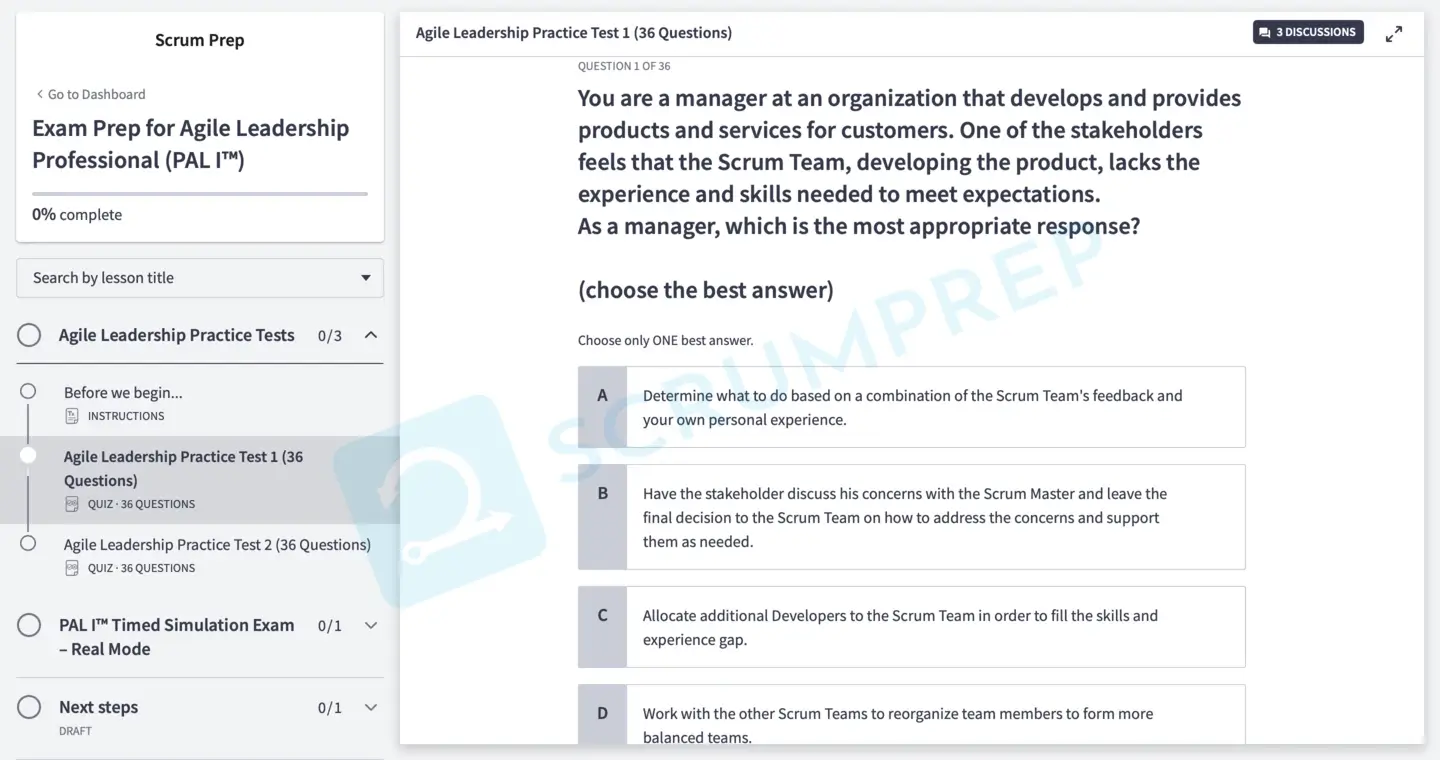
- Practice Mode: study at your own pace. Choose how many questions you want in each session, from a short set to every question in the bank, with no time limit and an in-depth explanation after every answer. Progress saves automatically.
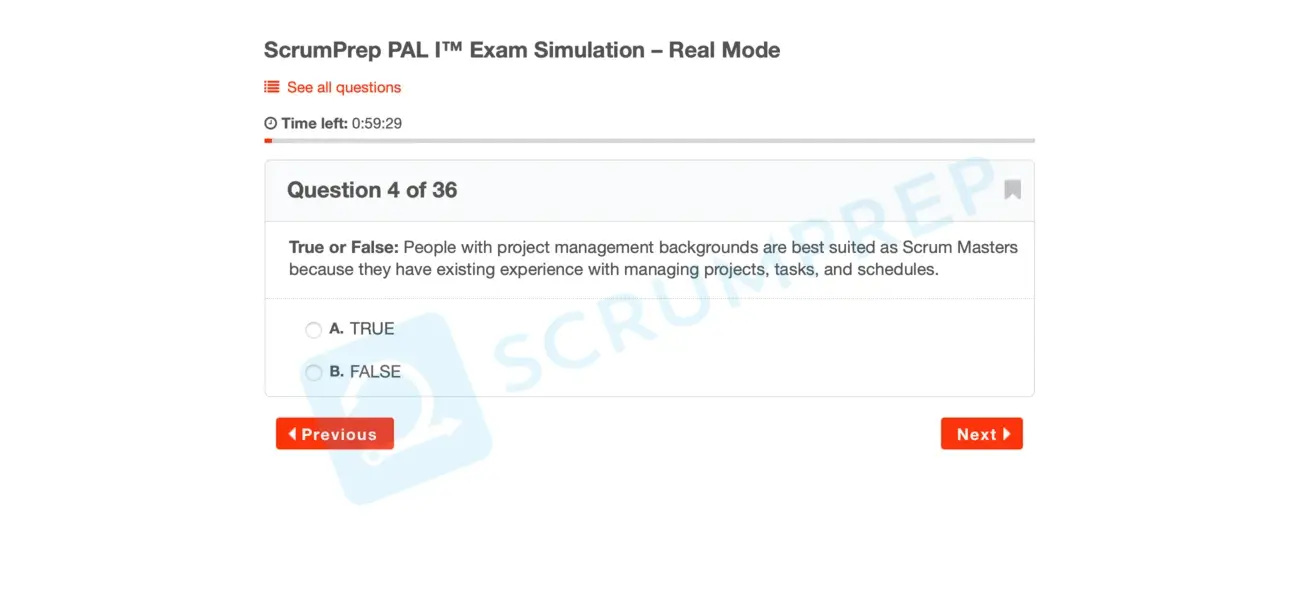
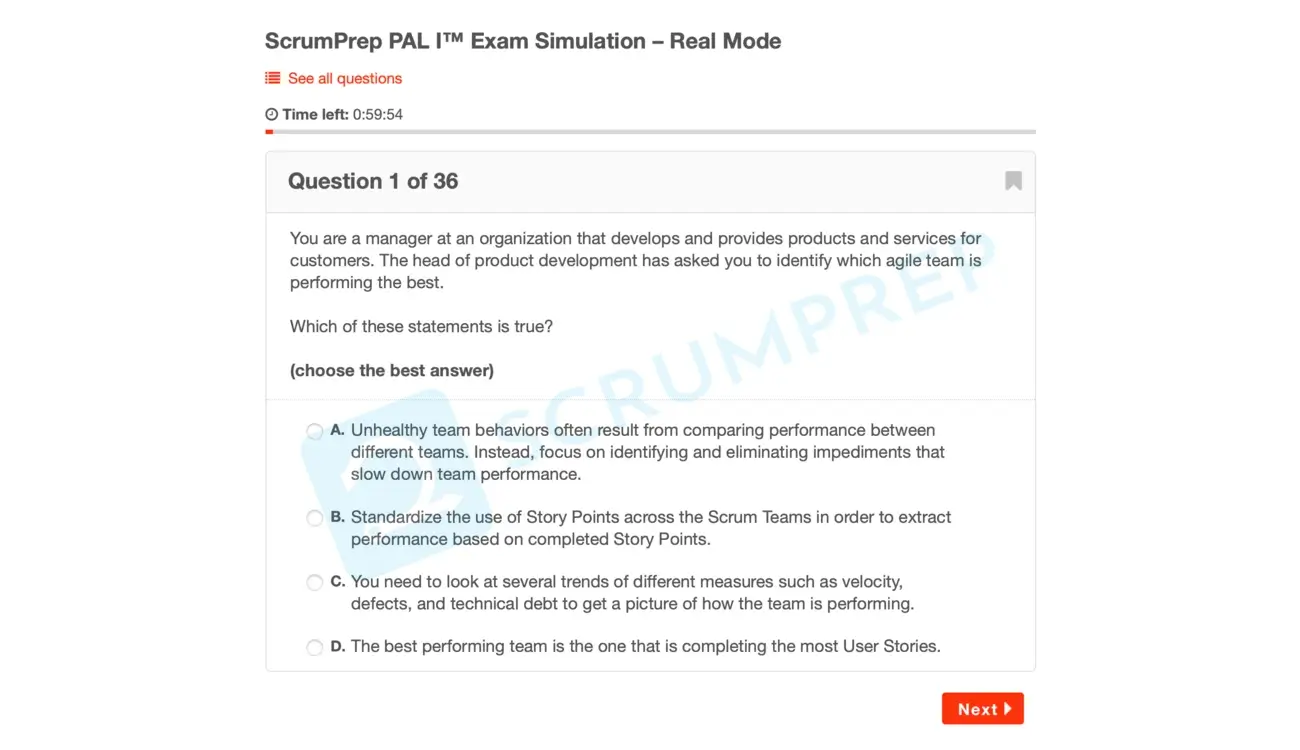
- Mock Exam Mode (Timed Mode): sit a full mock exam that mimics the real one: 36 random questions in 60 minutes, scored at the end. Every attempt draws a new random set.
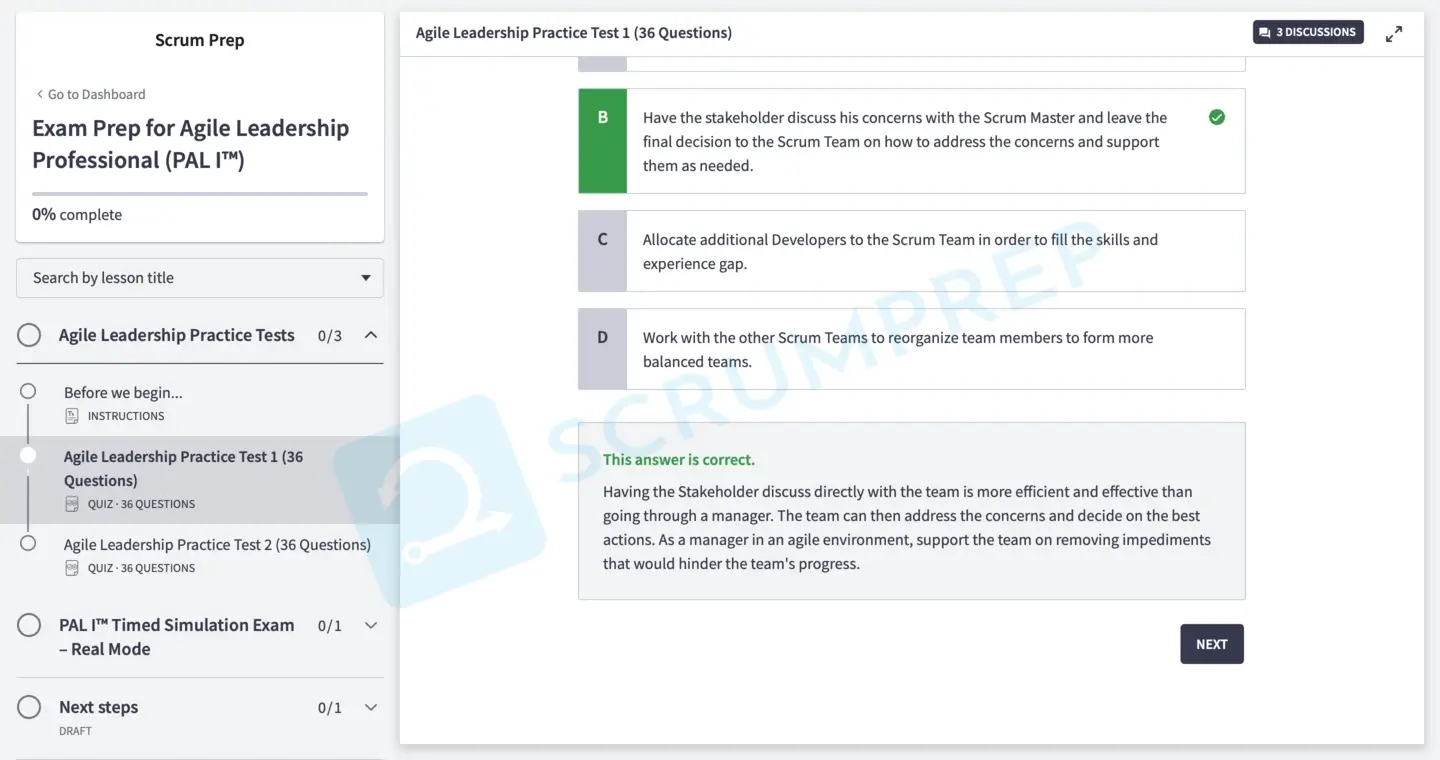
- In-depth explanations: every question comes with a detailed explanation that walks you through what the question is really asking and why the correct answer is right, so you understand the reasoning instead of memorizing answers.
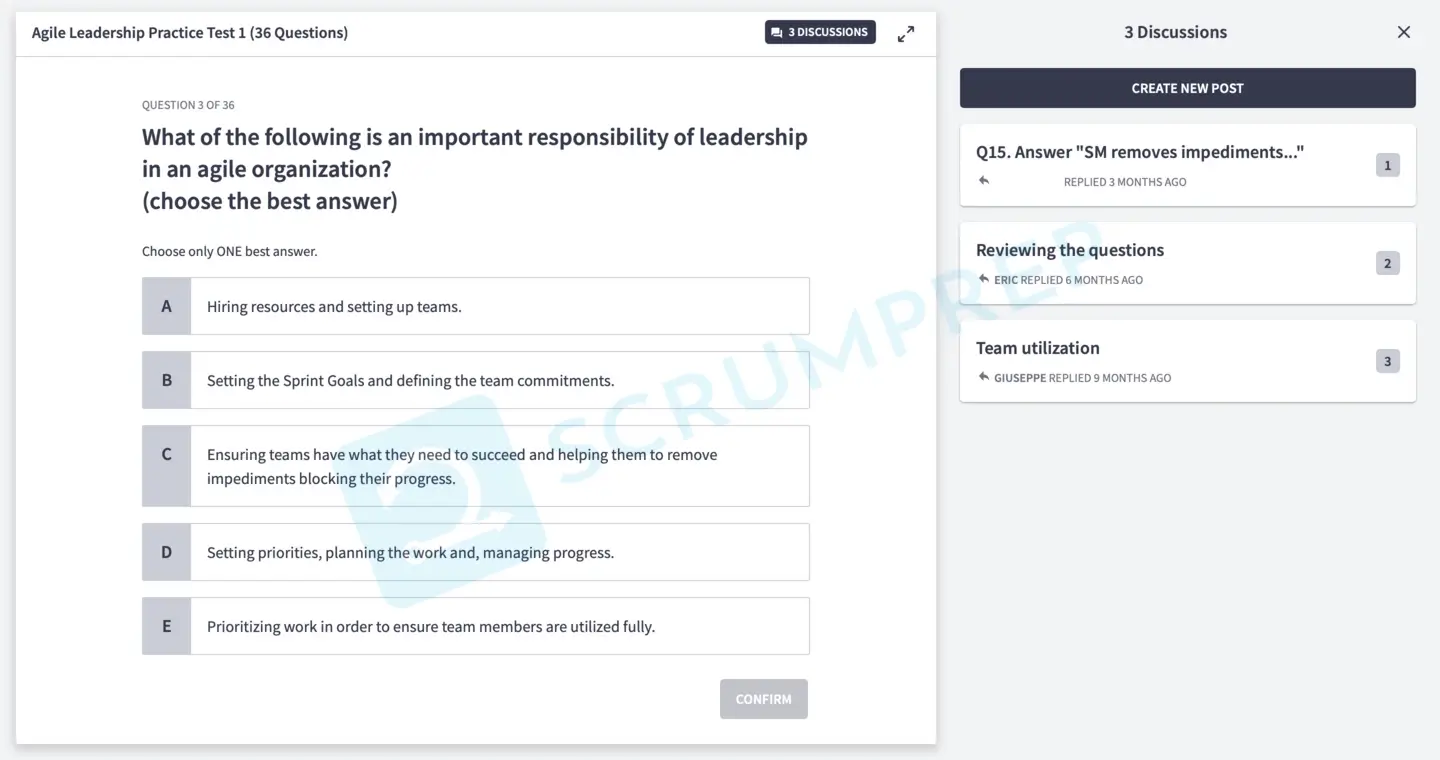
- Benchmarking: compare your scores with other candidates and see which topics need work.
- Lifetime access with updates whenever Scrum.org changes the exam.
Why ScrumPrep
Scrum.org’s free Agile Leadership Open assessment has only 15 questions, so it shows whether you are close but not where you are weak. Our bank of more than 70 questions covers every focus area with full explanations. Rated 4.97 out of 5 from more than 4,200 reviews, and backed by a 100% money-back guarantee.
- Trusted since 2016: thousands of candidates have prepared for their certification exams with ScrumPrep.
- Matched to the real exam: questions are written to match the real PAL I exam’s format, difficulty and topics, and checked against the current official exam content.
- Prompt support: questions about an answer or your account? Contact us and we respond promptly.
- Pay once: one payment, no subscription required.
- Study anywhere: practice on your phone, tablet or computer.
PAL I FAQ
Is PAL I the same as PAL 1? Yes. Scrum.org writes it with a Roman numeral, but it is the same exam.
Do I need to know Scrum? Yes, the basics. The exam assumes you know the Scrum Guide, then asks how leaders support it.
Is a course required? No. Scrum.org’s Professional Agile Leadership Essentials course is recommended but optional.
Is PAL I the same as PAL-EBM? No. PAL-EBM is a separate assessment on Evidence-Based Management. See our PAL-EBM practice tests.
Does PAL I expire? No. It is a lifetime certification with no renewal fee.
Are these real exam questions or dumps? Neither. Scrum.org’s real questions are confidential, and dumps break its rules and can cost you the certification. These are original questions written to the same format and topics, each with an in-depth explanation.
What if I don’t pass? Our money-back guarantee covers you. See the guarantee terms.
Read the free PAL I exam guide, or try the free PAL I quiz first.
Buying for a team? Bulk discounts are available. Contact us for details.

Olivia N. –
The questions showed how leaders create conditions for learning.
Grace N. –
I now mentor leaders using lessons I learned from this prep.
James L. –
I now coach leaders on how to remove systemic blockers to agility.
Liam G. –
This exam prep helped me embrace the mindset of an agile leader, not just a manager.
Jackson H. –
The questions made me think about how leadership impacts agility across the organization.
Olivia A. –
The content goes deeper than definitions—it teaches leadership mindset.
Emily G. –
This exam prep was more than a study tool—it was a mirror.
Olivia E. –
The explanations taught me how to role-model inspection and adaptation.
Logan T. –
Each question challenged me to step into the role of a leader, not just a practitioner.
Liam W. –
These questions taught me to focus on flow, feedback, and learning.