

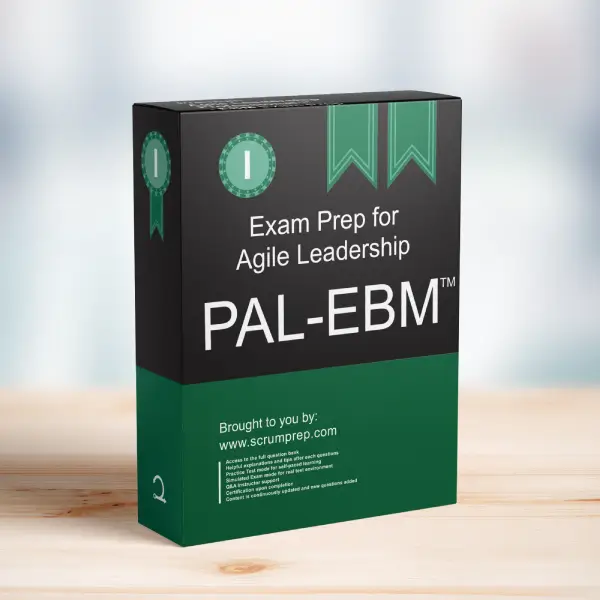
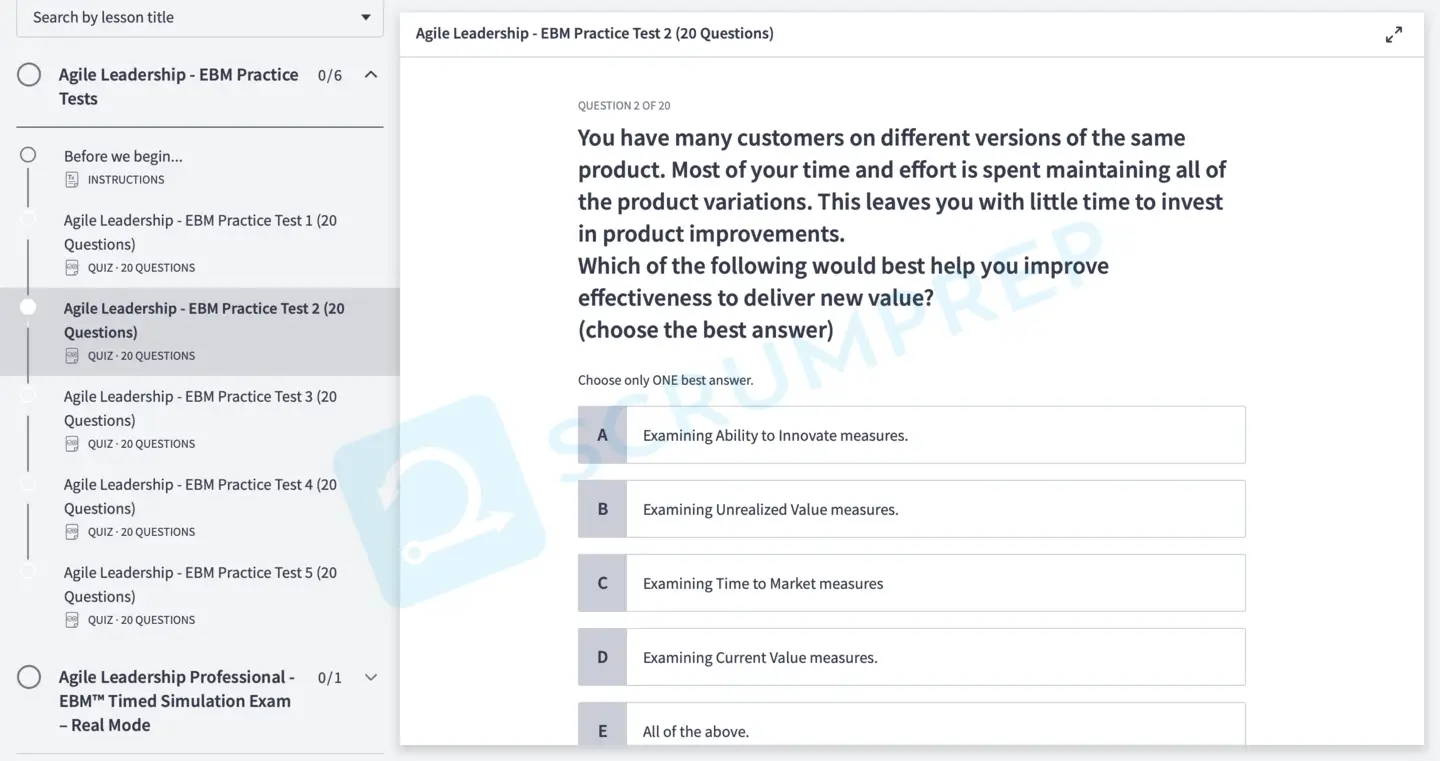
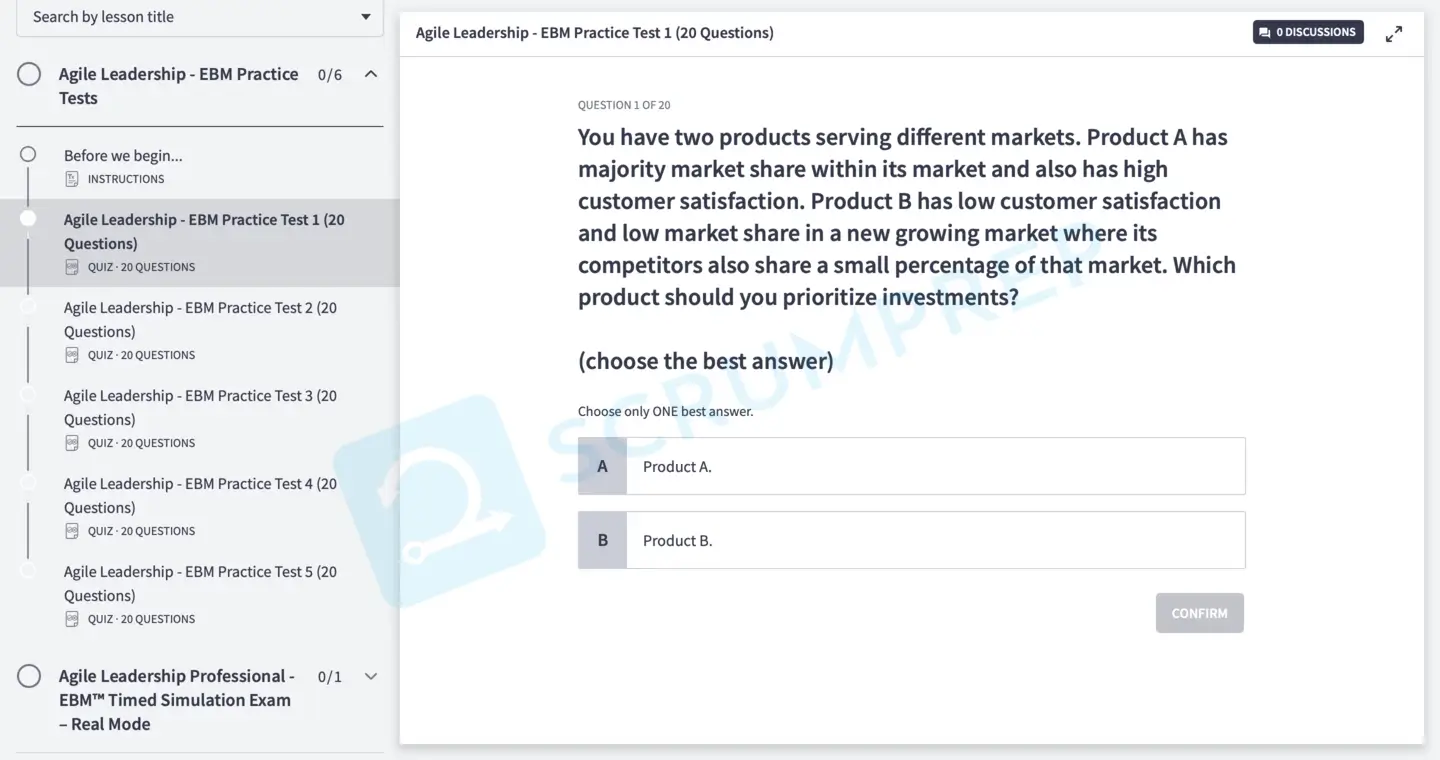
PAL-EBM exam questions and practice test
The Professional Agile Leadership – Evidence-Based Management (PAL-EBM) certification from Scrum.org checks whether you can use evidence to steer a product or organization. Questions cover the four Key Value Areas, setting Strategic, Intermediate and Immediate Tactical Goals, forming and testing hypotheses, and choosing measures that show value rather than activity. Our PAL-EBM exam questions follow the Evidence-Based Management Guide closely.
PAL-EBM exam at a glance
| Real PAL-EBM assessment | ScrumPrep PAL-EBM practice tests | |
|---|---|---|
| Questions | 40 | 100 in the bank; 40 per timed mock |
| Time limit | 60 minutes | 60 minutes in Timed Mode; none in Practice Mode |
| Passing score | 85% | Scored the same way, with a per-topic breakdown |
| Question types | Multiple choice, multiple answer, true/false | Same three types |
| Fee | $200 per attempt, paid to Scrum.org | $29, unlimited attempts |
| Based on | Evidence-Based Management Guide | The same |
What the PAL-EBM exam tests
- Key Value Areas: Current Value, Unrealized Value, Time to Market and Ability to Innovate.
- Goals: Strategic, Intermediate and Immediate Tactical Goals, and how they connect.
- Hypotheses and experiments: forming, testing and learning from hypotheses.
- Measures: choosing Key Value Measures and avoiding vanity metrics.
- Empiricism and leadership: using evidence to inspect and adapt products and portfolios.
Sample PAL-EBM exam question
Which Key Value Area describes how quickly an organization can deliver new capability, service or product to customers?
- Current Value
- Unrealized Value
- Time to Market
- Ability to Innovate
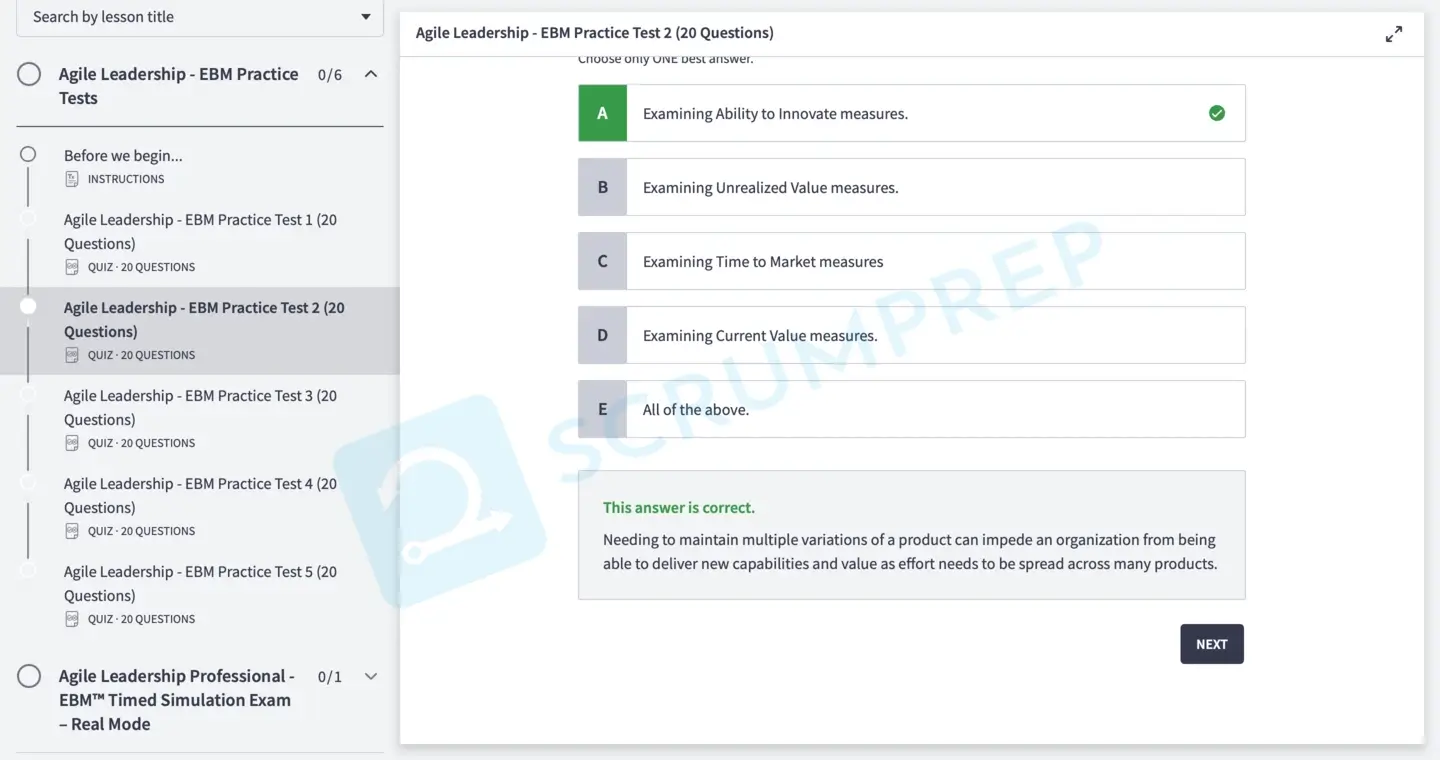
Answer: 3. Time to Market covers how fast an organization can learn and deliver, using measures such as lead time and release frequency. Ability to Innovate is about how well it can deliver new capability at all. Every question in our bank explains its answer like this.
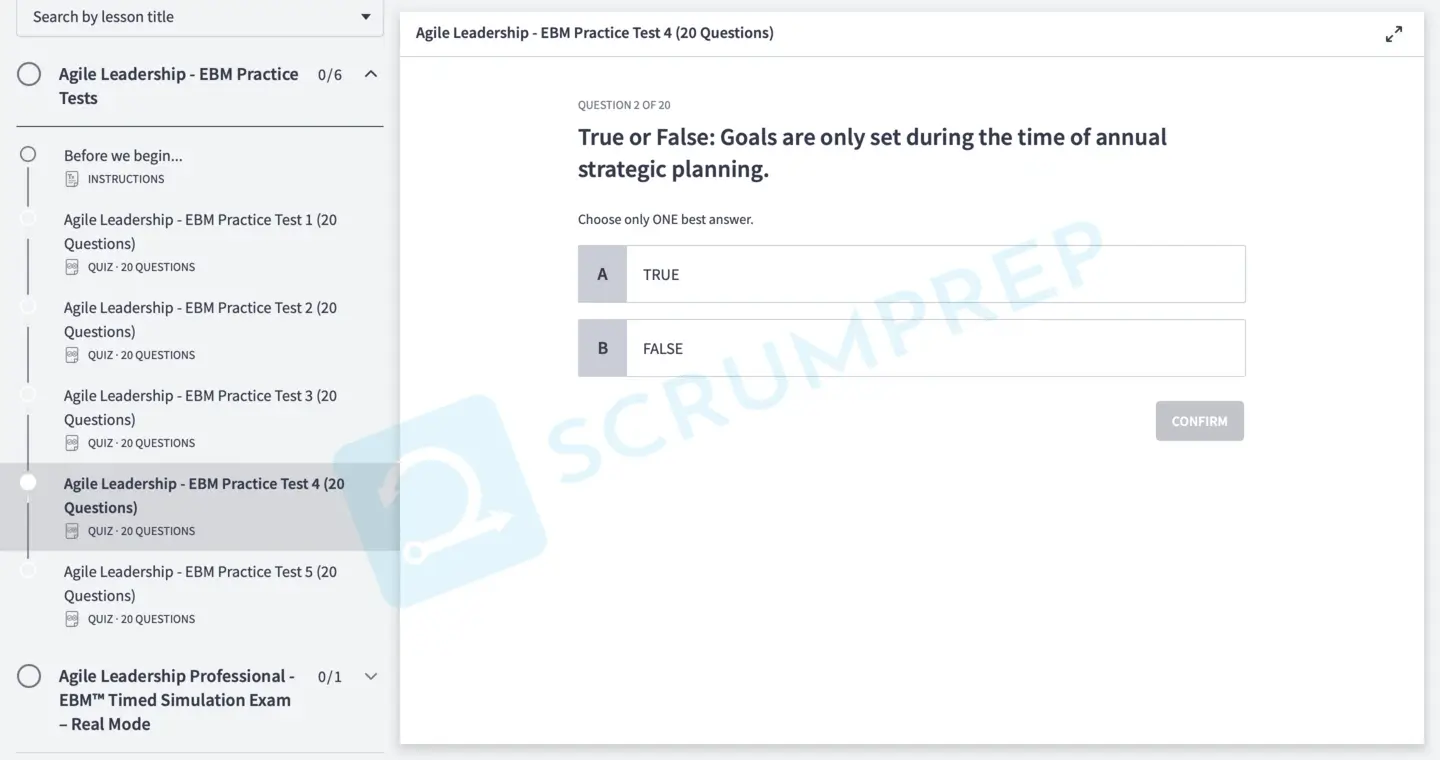
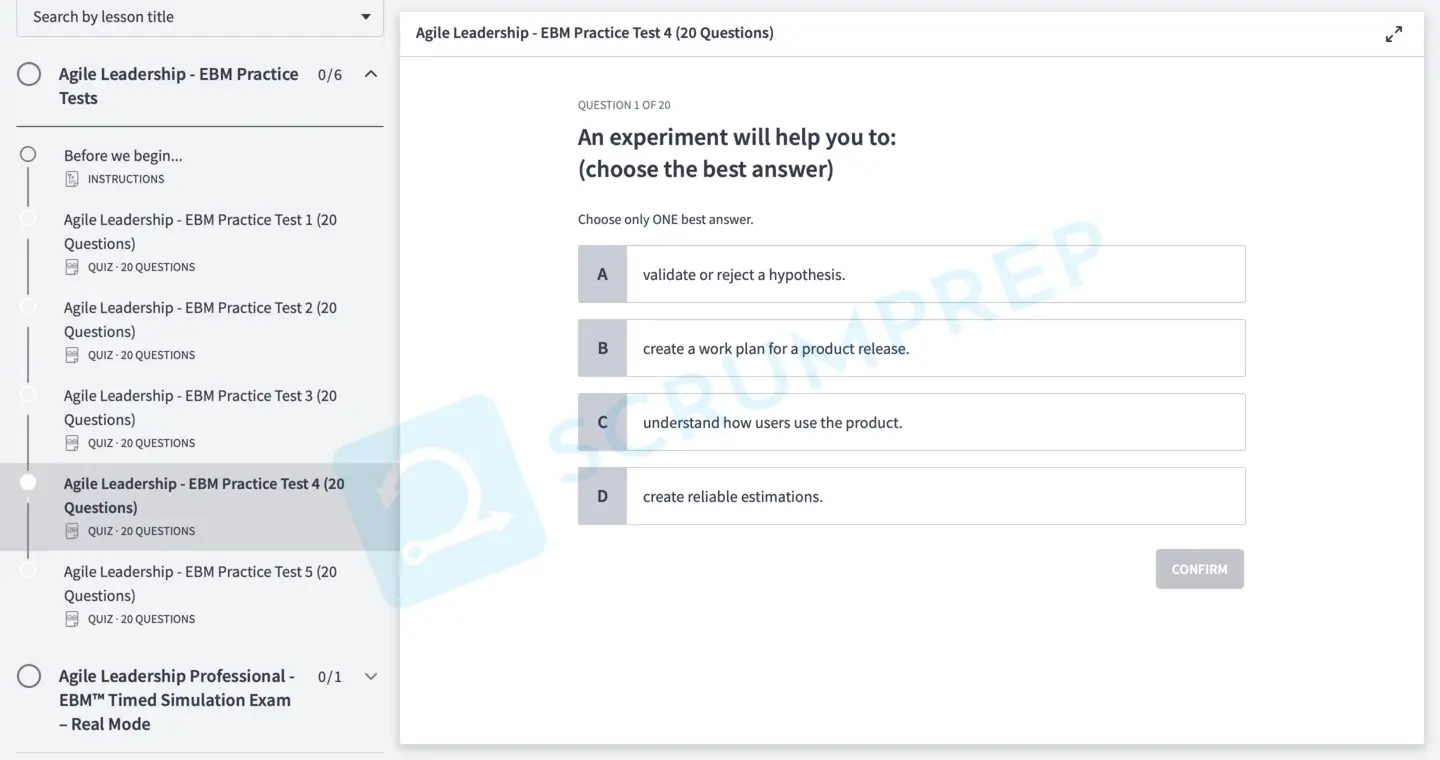
How the PAL-EBM practice tests work
- Practice Mode: all 100 questions, no time limit, with feedback after each answer. Progress saves automatically.
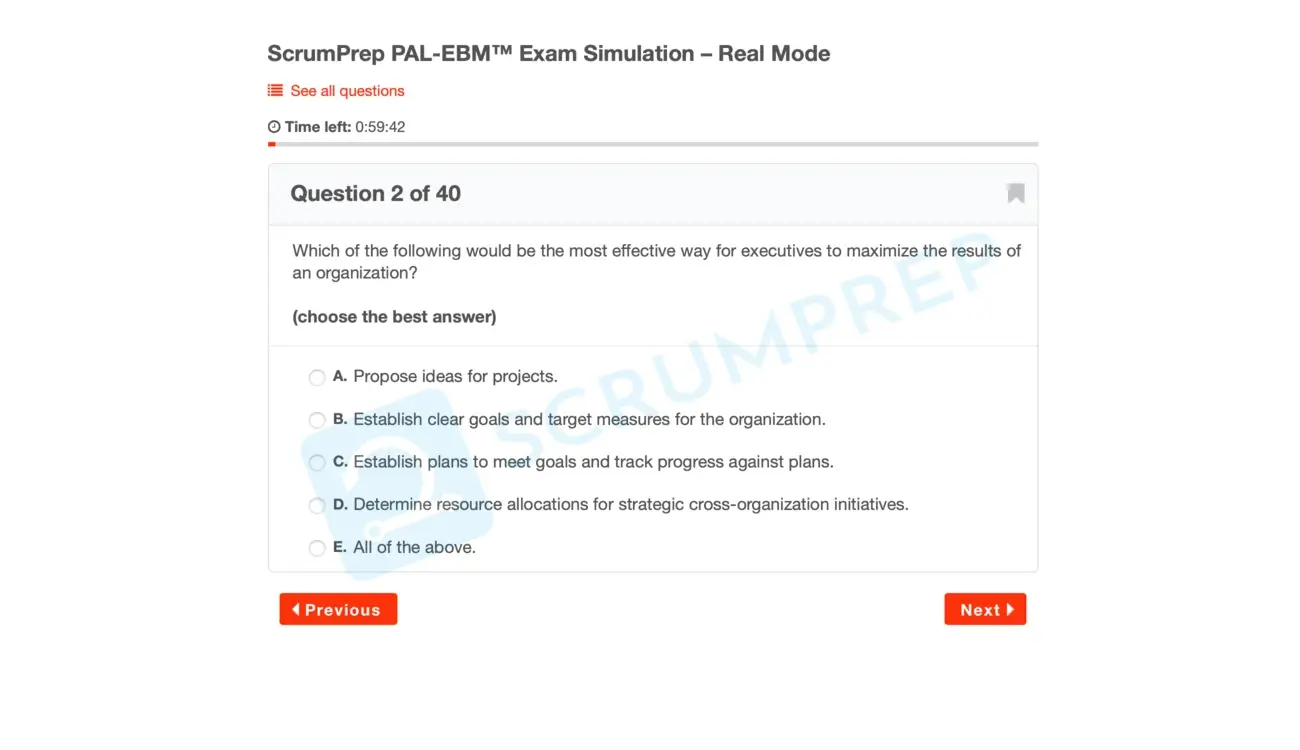
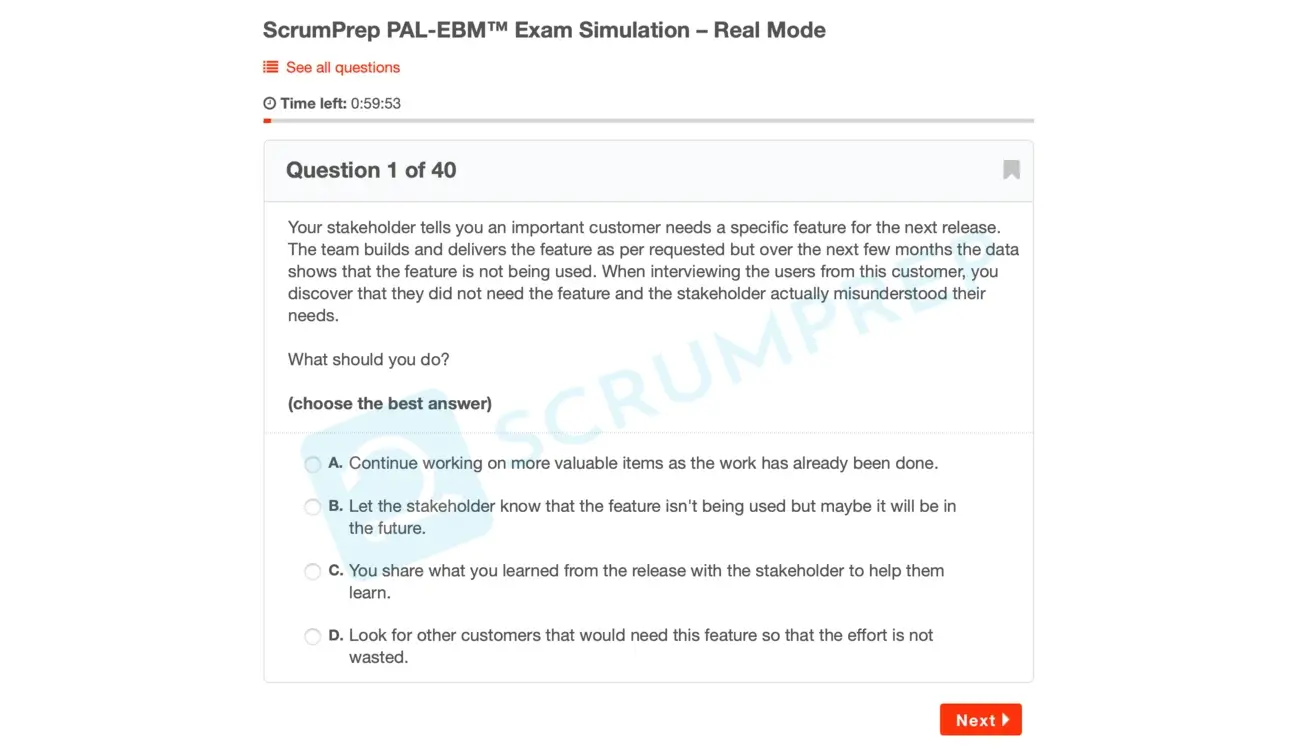
- Timed Mode: 40 random questions in 60 minutes, scored at the end, just like the real assessment.
- Custom test length: shorter sets for short study sessions.
- Benchmarking: compare your scores with other candidates and see which topics need work.
- Lifetime access with updates whenever Scrum.org changes the exam.
Why ScrumPrep
Scrum.org’s free Evidence-Based Management Open is a short check. Our 100 questions cover the whole EBM Guide at exam depth, with a full explanation for each. Rated 4.97 out of 5 from more than 4,100 reviews, and backed by our money-back guarantee.
PAL-EBM FAQ
Is PAL-EBM the same as PAL I? No. PAL I covers agile leadership in general. PAL-EBM focuses on Evidence-Based Management. See our PAL I practice tests.
Is a course required? No. Scrum.org’s Professional Agile Leadership – Evidence-Based Management course is recommended but optional.
What should I study? The Evidence-Based Management Guide is the main source. Know the Key Value Areas, the goal types and how experiments work.
Does PAL-EBM expire? No. It is a lifetime certification with no renewal fee.
Are these real exam questions or dumps? Neither. Scrum.org’s real questions are confidential, and dumps break its rules and can cost you the certification. These are original questions written to the same format and topics, each with an explanation.
What if I don’t pass? Our money-back guarantee covers you. See the guarantee terms.
Read the free PAL-EBM exam guide, or try the free PAL-EBM quiz first.
Buying for a team? Bulk discounts are available. Contact us for details.


Mia X. –
Elevated my confidence levels.
Ava S. –
Extremely helpful for review.
Olivia M. –
Well-structured practice material.
Grace N. –
Perfect for boosting your confidence.
Noah D. –
Improved my time management.
Ella D. –
Solidified my exam knowledge.
Daniel R. –
Passed with ease.
Emma S. –
Improved my weak areas.
Henry P. –
Boosted my exam performance.
Olivia C. –
Helped me achieve my certification goals.